
U6 Soccer Rules: What Changes by League
Most U6 (6U) leagues in the US play small-sided games — usually 3v3 or 4v4 — with no goalkeeper, a size 3 ball, and a short field. U.S. Soccer’s 2026 guidance goes even smaller, favoring unstructured 1v1-2v2 play with no standings. Exact game length and format still depend on your specific organization, so this breaks down what each one actually requires, with the page and date behind every number.
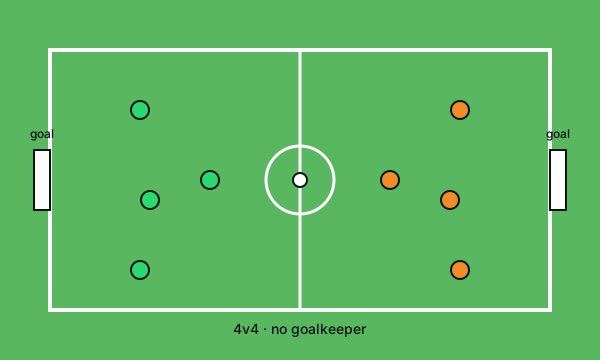 A typical U6 setup: 4v4, no goalkeeper, small goals at each end.
How many players are on the field at U6?
| Organization | What it says |
|---|---|
| US Soccer (2026 guidance) | “No Structure” — just 1v1, 2v1 or 2v2 play; no goalkeeper addressed |
| US Soccer (2017 small-sided standard, still the basis for most leagues) | 4v4, no goalkeeper |
| USYS | “No more than 4, 3 strongly recommended” per side; doesn’t say whether that includes a goalkeeper |
| AYSO | 4-a-side, no goalkeepers |
| Cal South | 4v4, goalkeeper “NO” |
| North Texas | 4v4 or 3v3 recommended; goalkeeper not addressed |
| Florida (FYSA) | No more than 4v4, no goalkeeper |
One national ceiling worth knowing: USYS state associations aren’t allowed to approve games for 10-and-under players with more than 8 players per side, no matter what else they decide locally.
One more format worth knowing about: AYSO’s Kickstart program for 5- and 6-year-olds is a separate track from AYSO’s regular U6 league, not an alternative name for the same thing. It runs as a weekly jamboree — new teams formed each week, 3v3 or 4v4 play across four small goals (sometimes marked cones instead), “game managers” on the field rather than a referee, and no standings. If your region offers both, ask which one your child is actually registered for.
Is there a goalkeeper at U6?
No, everywhere the question is directly addressed — AYSO, Cal South and Florida all say no goalkeeper at this age. USYS, North Texas and U.S. Soccer’s 2026 guidance set player counts without explicitly ruling a goalkeeper in or out.
How big is the U6 soccer field (and goal)?
Where it’s addressed, the field runs about 25-35 yards long by 15-25 yards wide, with goals no bigger than 4 feet high by 6 feet wide — that’s the figure in the PDI small-sided standards, AYSO’s referee guideline, Cal South’s matrix and North Texas’s rules. USYS and U.S. Soccer’s 2026 guidance don’t publish their own field dimensions for U6. AYSO’s Kickstart jamboree sometimes swaps standard goals for pop-up goals or marked cones instead. Fields and goals get bigger from U9 on: see soccer field size by age.
What size ball does U6 use?
Size 3, with no exceptions among the organizations that address it — PDI, USYS, AYSO, Cal South and North Texas. The exact weight and circumference differ slightly (USYS: 23-24 inches, 11-12 ounces; AYSO: 23-25 inches, 10-12 ounces) — check the size printed on the ball and your league’s spec rather than assuming one will fit both. When kids move up to a size 4, and why two 8-year-olds can need different sizes, is in soccer ball size by age.
How long is a U6 game?
There’s no single standard here — game length varies more than almost anything else at this age:
| Organization | Format | Total playing time |
|---|---|---|
| USYS | Four 6-minute quarters | 24 minutes |
| AYSO | Two halves, maximum 10 minutes each (per AYSO’s appendix) | Up to 20 minutes |
| PDI / Cal South | Four 10-minute quarters | 40 minutes |
| North Texas | Up to four 10-minute quarters (four 8-minute quarters recommended) | Up to 40 minutes (32 recommended) |
That’s a two-to-one difference between the shortest and longest version, both entirely legitimate under their own rules. Check your league’s handbook for the actual number.
How do U6 games restart — throw-ins or something else?
Not always a throw-in. AYSO replaces the U6 throw-in with a pass-in or dribble-in, with opponents kept at least two yards away. North Texas allows a re-throw if the first one is bad, or a kick-in instead. The 2017 PDI standards treat throw-ins, kick-ins and dribble-ins as equally acceptable. There’s no single rule here either — another reason a neighboring team’s restart can look completely different from your own.
Do offside, the build-out line or penalty kicks apply at U6?
No, everywhere these are directly addressed. The 2017 PDI standards, Cal South and North Texas all say there’s no offside and no build-out line at this age — the organizations we checked don’t use a build-out line at U8 and below. AYSO’s referee guide is less direct — it says these concepts “typically don’t apply” to players this young rather than ruling offside out explicitly, so AYSO’s guide suggests offside typically doesn’t apply at this age rather than stating a flat exemption.
Penalty kicks don’t exist at U6 either: AYSO doesn’t introduce them until U9, and North Texas says explicitly there are no penalty kicks at 8U and younger — fouls that would be a penalty at older ages get an indirect free kick instead.
Who referees a U6 game?
It depends on the league. The 2017 PDI standards say certified referees aren’t needed at this level at all. North Texas allows a parent, coach or assistant coach to referee — though only a registered referee can actually caution or send off a player. Other leagues use certified youth referees. None of this is standardized, so “who’s the ref” is genuinely a check-your-league question.
Is heading allowed at U6?
No heading at all, in games or in practice. U.S. Soccer’s current coaching guidance, US Youth Soccer, AYSO, North Texas and Florida all say so explicitly; Cal South’s matrix just says “NO” without separately calling out practice, but the intent is the same. Under US Youth Soccer’s and AYSO’s rules, a deliberate header in a game gives the other team an indirect free kick.
If a child takes a knock to the head, stop play. If you suspect a head injury, keep them out for the rest of the day, let their parents and your league contact know, and follow your league’s concussion protocol and a health professional’s advice. That’s deliberately cautious — your league’s protocol has the final word.
Other safety basics at U6 games
- Heat: let kids drink water whenever they want, with no limit, and build in breaks. U.S. Soccer’s heat guidance calls for adapting the session to the conditions — shorter games, more breaks, or postponing to a cooler time — rather than pushing through. Ask your league how it handles heat advisories; this isn’t the place for specific numbers, since the right call depends on conditions on the day.
- Thunder: if anyone hears thunder, get everyone to shelter immediately. AYSO’s guidance is direct about this, and it’s good practice no matter which league you’re in.
- Goals: Secure portable goals the way the manufacturer says (stakes on grass, weights on hard surfaces), check them before use, and never let anyone climb or hang on a goal. The CPSC’s guidelines are written for full-size movable goals, but the same habits apply to small ones. Before you buy a goal, new or used, search cpsc.gov for recalls and warnings.
Why does my U6 team’s format look different from the “standard”?
4v4 with no goalkeeper is the format you’ll see repeated most often online, but it’s not the only legitimate one. USYS actually recommends 3v3 (allowing up to 4 per side), North Texas allows 3v3 as well as 4v4, and AYSO’s Kickstart program plays an entirely different jamboree format with four goals instead of two. Game length varies even more, from 20 minutes total in one league to 40 in another. None of that means your league is doing something wrong — check your league’s handbook. It has the final word, not this page or any other.
FAQ
How many players on a U6 soccer team (roster, not on the field)? Rosters run small. AYSO caps a U6 roster at 6 players (minimum 5). North Texas recommends 6, with a maximum of 8. Check your own league’s roster limit — it varies by organization.
Does U6 soccer keep score? Mostly, no — or at least, it’s not supposed to matter. The 2017 PDI standards say results and standings shouldn’t be recorded at this age, and North Texas bars competitive leagues entirely at 6U, 8U and 10U. USYS lets ties simply stand at 6U, with no overtime.
What age is U6 in 2026-27? In leagues using the August 1 cutoff, U6 covers kids born between August 1, 2020 and July 31, 2021. See our age groups guide and calculator for leagues that use a different date, including North Texas.
For the next age up, see our U8 soccer rules breakdown, and for how rec fits in among travel, select and premier, see youth soccer levels explained.
Sources
- U.S. Soccer, Age-Appropriate Formats (“The U.S. Way,” 2026) — ussoccer.com
- U.S. Soccer, Player Development Initiatives (2017) — usyouthsoccer.org
- U.S. Soccer, Coaching Guide: U7-U8 (2026) — ussoccer.com
- US Youth Soccer (USYS), Policy on Players and Playing Rules (as of June 23, 2026) — usyouthsoccer.org
- AYSO, Referee Guideline 2026-27 — wiki.ayso.org
- Cal South, 2026-27 PDI Matrix — calsouth.com
- North Texas Soccer (NTSSA), Bylaws and Rules 2026/2027 — ntxsoccer.org
- Florida Youth Soccer (FYSA), Rules (last modified August 2026) — fysa.com
- U.S. Soccer, Recognize to Recover — Heat Guidelines — via folsomlakesurf.org
- U.S. Consumer Product Safety Commission, Guidelines for Movable Soccer Goals — cpsc.gov

Peter D. — Peter D. is KickZone’s editor. Based in Spain and closely involved in grassroots youth soccer there, Peter turns the way Spanish kids learn the game into practical help for US parents and volunteer coaches. Rules always come straight from the official rulebooks, cited.