
Soccer Ball Size by Age: 3, 4 or 5? A Chart by Age Group
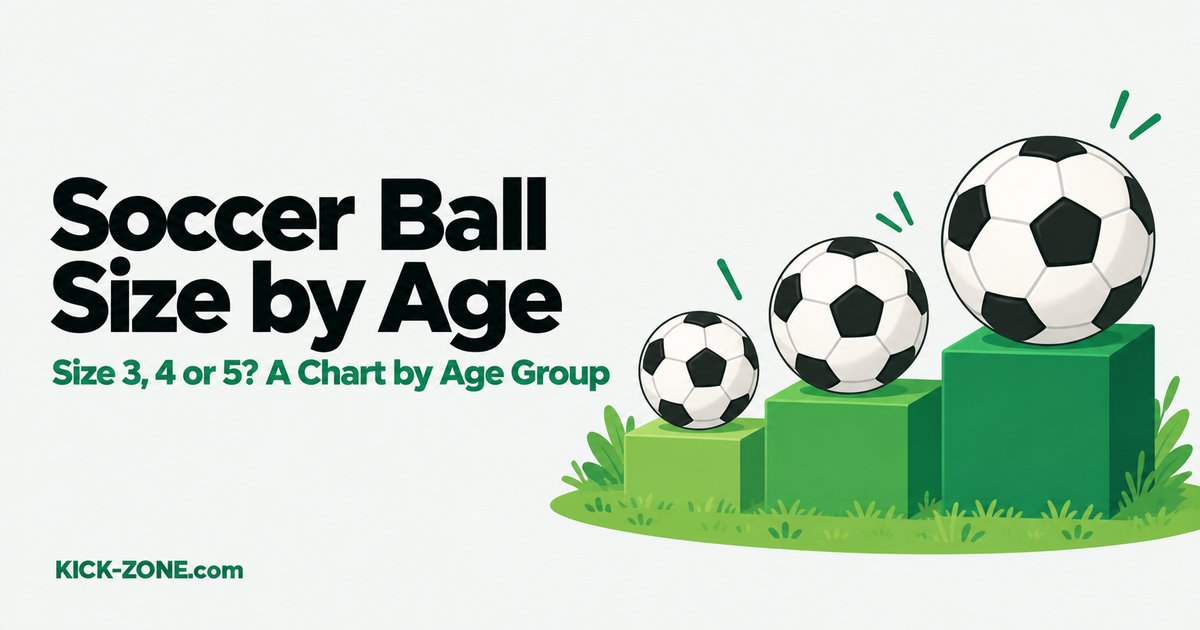
Youth soccer uses three ball sizes, and the age group decides, not the birthday. In the rulebooks I checked, games use a size 3 through U8, a size 4 from U9 (or 10U) through U12, and a size 5, the adult size, from U13 up. US Youth Soccer, AYSO, Cal South and North Texas agree. If your child is 8, check their age group first: U8 plays with a size 3, U9 with a size 4.
Which ball to buy comes up often when parents ask online what gear their child needs, and the size charts they find don’t always match the rulebooks.
Soccer ball size chart by age group
| Ball size | Age groups | Who’s in it (leagues with an August 1 cutoff, 2026-27) |
|---|---|---|
| Size 3 | U8 and younger (US Youth Soccer: 6U and 8U) | Kids who turn 8 or younger between August 1, 2026 and July 31, 2027 (about ages 4-8) |
| Size 4 | U9 to U12 (US Youth Soccer: 10U, 11U and 12U; North Texas: 10U and 12U) | Kids who turn 9 to 12 in that window (about ages 8-12) |
| Size 5 | U13 and older | Kids who turn 13 or older in that window (about 12 and up), and adults |
These are the breaks in US Youth Soccer’s Rule 303, AYSO’s 2026-27 referee guideline, Cal South’s 2026-27 matrix and North Texas’s 2026/27 rules. Florida’s rules say to “Follow US Youth Soccer requirements for field size, ball size, etc.” The ball-size tables I checked list only sizes 3, 4 and 5.
The ages are my arithmetic for leagues that group players from August 1 to July 31, as US Youth Soccer and AYSO do in 2026-27, and they’re approximate. Leagues with another cutoff shift them (North Texas, for example, still counts age on December 31), so check your league’s registration page.
Does ball size change the heading rules?
No. A smaller, lighter or softer ball doesn’t make heading OK. For kids U8 and younger, every rulebook I checked says no heading, and most spell out that this covers practice too:
- U.S. Soccer: “No heading in practice or games,” in its current coaching guides for U5, U7-U8 and U9-U10.
- US Youth Soccer, Rule 305: players 10 and under “shall not head the ball directly from the air in any match or competition, nor shall these players practice heading the ball in any organized team setting.” The rule is mandatory in US Youth Soccer’s own competitions, and state associations are “strongly encouraged” to adopt it. Florida has the same rule in its own rulebook.
- AYSO: “Heading is banned for all division players U11, and below (U12, and below for programs without single-age divisions) in both practices and matches.”
- North Texas: “12U and younger recreational play shall not engage in heading, either in practices or in games.”
- Cal South: its matrix lists heading as “NO” from 5U to 11U.
So for young kids: no heading, with any ball, in any game or drill. That includes light or foam balls, and balloons or beach balls aren’t a way around it.
For older kids, the limits differ by organization, so don’t mix them. US Youth Soccer allows heading in games at ages 11 and 12, and in practice coaches keep each player to no more than 25 headers a week. U.S. Soccer’s current guide says no heading at U11 and, at U12, no more than 30 minutes of heading practice and 15-20 headers per player per week. AYSO bans it through U11 (U12 in programs without single-age divisions). Check your league’s rule.
If a child takes a knock to the head, stop play. If a head injury is suspected, the child sits out the rest of the day, even if they say they feel fine. That’s our own rule, on the cautious side. Tell the family and your league, follow the league’s concussion protocol, and get a health professional’s OK before they play again.
What size soccer ball for a 4-, 5-, 6-, 7- or 8-year-old?
A size 3, in every rulebook that covers these ages: US Youth Soccer (6U and 8U), AYSO (Schoolyard, U6, U7 and U8), Cal South (5U to 8U) and North Texas (8U and 6U). AYSO’s Kickstart program for 5- and 6-year-olds asks each child to bring a “Size 3 soccer ball (labeled with initials or last name).” That’s Kickstart’s equipment list, not a rule for every program: others may supply balls, so ask your coach.
Why two 8-year-olds can need different balls. In a league with an August 1 cutoff, a child born on October 15, 2018 and one born on March 15, 2018 are both 8 from October 15, 2026 to March 14, 2027 (my arithmetic). The first turns 8 during the season, so they’re U8 and play with a size 3. The second turns 9 in March, so they’re U9 and move to a size 4. In AYSO, which groups two birth years together, they land in 8U (born August 1, 2018 to July 31, 2020) and 10U (born August 1, 2016 to July 31, 2018). Find your child’s group with our age group calculator.
Some charts online put every 8-year-old on a size 4. The rulebooks go by age group instead.
One nuance for practice: Massachusetts Youth Soccer, a US Youth Soccer state association, tells U8 coaches that the ball each child brings to sessions can be “size 3 or 4 (size 5 is too big for this age group).” That’s its practice equipment list, not a game rule; in games, U8 uses a size 3 in every rulebook above. Check with your coach.
The rest of the U8 rules are in our U8 soccer rules guide.
When do kids move up to a size 4, and then a size 5?
Size 4: from U9 in AYSO (U9 to U12) and Cal South (9U to 12U), and at 10U, 11U and 12U in US Youth Soccer; North Texas lists it for 12U and 10U. It’s the same step with a different label: those two tables have no 9U row, and US Youth Soccer’s 10U means “10 years of age and under.” The switch lines up with the move to 7v7 with a goalkeeper and a bigger field: see soccer field size by age.
Size 5: from U13 in all four: US Youth Soccer (13U to 19U), AYSO (U13 and older), Cal South (13U to 19U) and North Texas (“13U and older”). It matches the ball the Laws of the Game define for matches: 68-70 cm (27-28 inches) around.
How big is each size? (circumference and weight)
| Size | US Youth Soccer (Rule 303) | AYSO (2026-27 guideline) | Laws of the Game (Law 2) |
|---|---|---|---|
| 3 | 23-24 in, 11-12 oz | 23-25 in, 10-12 oz | Not covered |
| 4 | 25-26 in, 11-13 oz | 25-26.5 in, 12-14 oz | Not covered |
| 5 | 27-28 in, 14-16 oz | 26.5-28 in, 14-16 oz | 68-70 cm (27-28 in), 410-450 g (14-16 oz) at the start of the match |
The exact numbers differ a little between organizations, so buy by the size printed on the ball. Youth sizes exist because the Laws of the Game only define the match ball and let national associations modify the “size, weight and material of the ball” for youth and grassroots football.
How much air should a youth soccer ball have?
Inflate it to the range the manufacturer prints on the ball, or gives in its instructions, and don’t go over it. None of the youth rulebooks I checked (US Youth Soccer, AYSO, Cal South and North Texas) gives a pressure for a size 3 or 4.
The only official figure is for the match ball in the Laws of the Game: “0.6–1.1 atmosphere (600 –1,100 g/cm²) at sea level (8.5lbs/sq in–15.6 lbs/sq in).” That’s the regulation match ball, not a spec for a size 3 or 4. Pressure figures you’ll find online vary a lot for the same size, so the range on your own ball is the one to follow.
AYSO’s referees check the ball before every game “for proper inflation, size, and safety (no surface cuts).” It’s a quick check worth copying before practice.
Buying a ball for practice: what to check
- The size printed on the ball, matched to your child’s age group in the chart above.
- Whether your program wants each child to bring one. AYSO’s Kickstart does, labeled with the child’s initials or last name; other programs may supply balls, so ask your coach.
- Air and surface: inflated to the printed range, with no cuts in the surface.
For the rest of the bag, see what to bring to soccer practice.
FAQ
What size soccer ball for a 5-year-old?
A size 3, in every rulebook that covers U5-U6.
Is a size 4 ball OK for a 7-year-old?
In games, the rulebooks use a size 3 through U8. For the ball kids bring to practice, Massachusetts Youth Soccer’s U8 guide allows “size 3 or 4.” Check with your coach.
When do players switch to a size 5?
At U13 (13U), in US Youth Soccer, AYSO, Cal South and North Texas.
Do sizes 1 and 2 count for youth soccer?
The ball-size tables I checked (US Youth Soccer, AYSO, Cal South and North Texas) list only sizes 3, 4 and 5.
What ball does futsal use?
Futsal uses its own ball. See futsal vs. soccer for how the two games compare.
Sources
- US Youth Soccer (USYS), Policy on Players and Playing Rules (as of June 23, 2026), Rules 303 and 305 — usyouthsoccer.org
- AYSO, Referee Guideline 2026-27 (Law 2 appendix table, heading, pre-game checks) — wiki.ayso.org
- AYSO, Age Group Chart, Starting Fall 2026 Season — ayso.org
- AYSO, 6U Kickstart Program Manual — wiki.ayso.org
- Cal South, 2026-27 PDI Matrix — calsouth.com
- North Texas Soccer (NTSSA), Bylaws and Rules 2026/2027 — ntxsoccer.org
- Florida Youth Soccer (FYSA), Rules (last modified August 2026) — fysa.com
- U.S. Soccer, Coaching Guide: U5 (2026) — ussoccer.com
- U.S. Soccer, Coaching Guide: U7-U8 (2026) — ussoccer.com
- U.S. Soccer, Coaching Guide: U9-U10 (2026) — ussoccer.com
- U.S. Soccer, Coaching Guide: U11-U12 (2026) — ussoccer.com
- Massachusetts Youth Soccer, Survival Guide: 4v4 (U8) — mayouthsoccer.org
- The IFAB, Laws of the Game 2026/27, Law 2: The Ball — theifab.com
- The IFAB, Laws of the Game 2026/27, General Modifications — theifab.com

Peter D. — Peter D. is KickZone’s editor. Based in Spain and closely involved in grassroots youth soccer there, Peter turns the way Spanish kids learn the game into practical help for US parents and volunteer coaches. Rules always come straight from the official rulebooks, cited.