
Futsal vs. Soccer: The Real Rule Differences, Explained
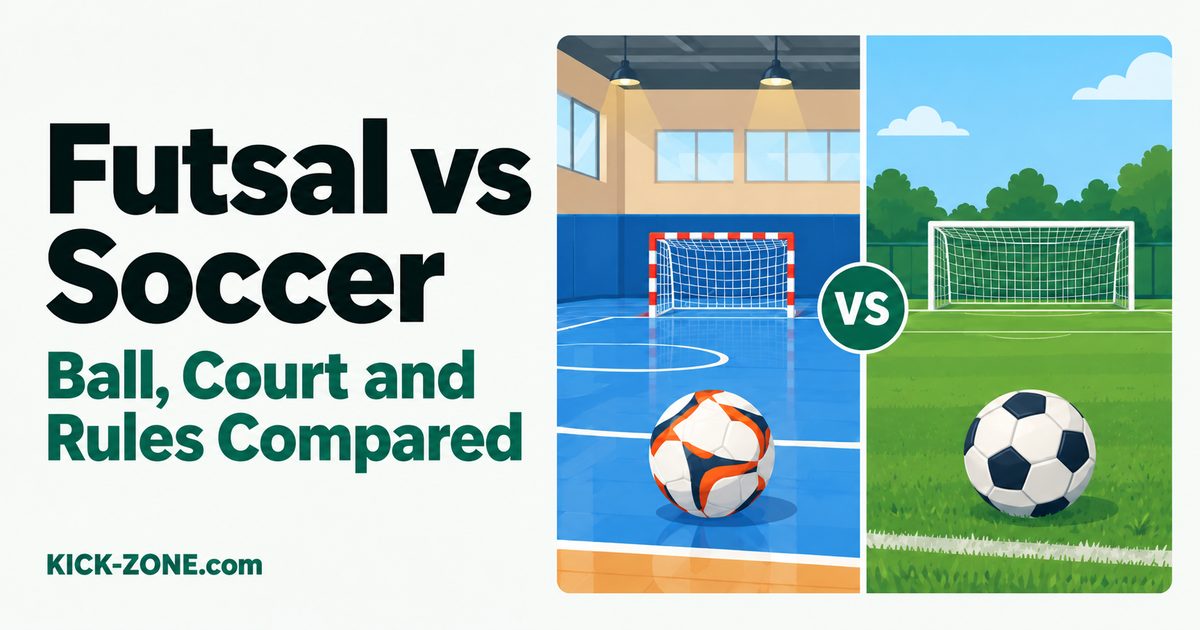
Futsal is played indoors, 5-a-side (4 players plus a goalkeeper), with a smaller, low-bounce ball and no offside rule. Outdoor rec soccer at these ages ranges from 1v1-2v2 at U5-U6 under U.S. Soccer’s 2026 guide up to the 4v4, no-goalkeeper format AYSO, North Texas and Cal South run at U6-U8 rec, on a much bigger field. In Spain, many young kids start with futsal or other small-sided formats alongside outdoor soccer. In the US, many parents mention futsal as an indoor winter option — not a replacement for your league’s outdoor season.
What are the actual rule differences between futsal and soccer?
Most comparisons online describe futsal in general terms — faster, smaller, more touches — without actually putting the two rulebooks side by side. Here’s what each one says, rule by rule:
| Futsal | Outdoor soccer (U5-U8 rec) | |
|---|---|---|
| Players per side | 5 total (4 players + a goalkeeper) | 1v1-2v2 at U5-U6 (U.S. Soccer’s 2026 guide); usually 4v4 with no goalkeeper at U6-U8 rec (AYSO, North Texas, Cal South); varies by league, and some travel teams add a keeper |
| Ball | Smaller, low-bounce ball | Size 3 |
| Court / field | Indoor court, roughly the size of a basketball court | About 25-35 by 15-25 yards outdoors |
| Offside | None | Not used at this age by most organizations we checked either |
| Substitutions | Unlimited, on the fly | Also unrestricted at this age in most leagues, though US Youth Soccer requires a stoppage in play and the referee’s consent |
| Restarts | Kick-in instead of a throw-in | Throw-in, kick-in or dribble-in, depending on the league |
Futsal column: FIFA’s Futsal Laws of the Game. Soccer column: the same official rulebooks (AYSO, US Youth Soccer, North Texas, and others) we cite in our U6 and U8 rules guides — rules vary by organization and program, so check your own league’s handbook too.
Why does Spain start so many young kids on futsal?
What I see in grassroots soccer in Spain is that a lot of young kids meet the game through futsal or other small-sided formats before, or alongside, full 11-a-side soccer. Part of it is practical: futsal gives you a space that’s sheltered from rain and cold, which matters for a sport that otherwise depends entirely on the weather. Part of it is about the game itself — a smaller, more controlled space means there’s more room to actually work on technique and positioning instead of just chasing the ball across a huge field. The surface helps too; it rewards a clean first touch and an accurate pass in a way a bumpy outdoor field doesn’t always. None of that makes futsal “safer” than outdoor soccer — it’s still a fast, physical game, just played indoors — but it’s easy to see why so many clubs use it as a starting point.
Is futsal a good winter option for US rec soccer families?
If your outdoor field is unplayable for a chunk of winter — frozen, dark by 5 p.m., or just miserable — futsal is a reasonable alternative, not a wholesale replacement for your league’s outdoor season. US Youth Futsal is the national organization for the sport in the US; if there’s a local program near you, it’s worth asking directly what age groups and ball size they actually use, since we couldn’t confirm those specifics from an official document for this article. Futsal isn’t entirely separate from outdoor soccer’s own governing bodies, either — North Texas Soccer’s bylaws list “outdoor soccer, indoor soccer, and Futsal soccer” side by side as formats the association covers. Whatever program you find, treat it as a supplement to your outdoor rec season, not a substitute for the rules your actual league plays by outdoors. Practically, that usually means a short indoor session or two during the coldest or wettest stretch of the year, run by whoever has gym access locally — a park district, a club, or a school — rather than a parallel season with its own standings.
Does futsal help with soccer skills?
Futsal’s format is built around more touches per player in a tighter space — that’s simply what a smaller court with 5 players (instead of 11) produces, combined with a low-bounce ball that stays closer to the floor and rewards a clean first touch over a big kick. Futsal federations often describe this as good for close control and quick decision-making under pressure, since there’s less time and space to think between touches than on a full-size field. We haven’t found an independent study to cite on exactly how much of that transfers to outdoor soccer, so take it as a reasonable theory rather than a guarantee: more touches in training is a good thing for a 6-year-old regardless of which sport delivers them, and outdoor small-sided games at U5-U8 are already designed to do much the same thing.
A few safety basics that don’t change indoors
Playing indoors doesn’t make the game risk-free. It’s still contact, still fast, and gyms can get warm enough that the same water-break habits that apply outdoors still matter — a closed gym with bad airflow on a warm day isn’t automatically cooler than the field. A hard court floor also means falls land differently than they do on grass, which is worth a moment’s thought if your child is more used to playing on turf. Futsal goals are a special case: FIFA’s futsal rules say goals must not be fixed to the floor and need a stabilizing system, such as weight at the back, so they can’t tip over. Before you buy a goal, new or used, search cpsc.gov for recalls and warnings. On heading: outdoor youth organizations ban heading at U5-U8 (AYSO, North Texas and Florida; US Youth Soccer makes it mandatory in its own competitions and strongly encourages it for local play). FIFA’s futsal rules don’t set age-based heading limits, so check your futsal program’s rules — and keep heading out of practice at this age either way.
FAQ
Is futsal the same as indoor soccer?
No. “Indoor soccer” at many facilities uses walls and locally-set rules that vary place to place. Futsal has one official rulebook worldwide — FIFA’s Futsal Laws of the Game — though FIFA’s own rules allow adaptations for youth and grassroots play, so it’s still worth checking your local program’s exact rules.
What ball size does futsal use for young kids?
FIFA’s official futsal ball is about 24.4 to 25.2 inches around, built for a low bounce rather than just being smaller than an outdoor ball — the FIFA spec calls for a bounce of roughly 20 to 26 inches when dropped from about 6.5 feet. FIFA’s own rules allow organizations to adapt the format for younger and grassroots players, so the exact ball your child uses will depend on the local program — ask before you sign up.
Can my 6-year-old play futsal instead of soccer?
We can’t give you a confirmed age-group answer for organized US Youth Futsal from an official document, and local programs vary — that’s worth asking about directly rather than assuming either way. What we can say: as an occasional indoor alternative or winter supplement, there’s no reason a 6-year-old can’t try it, with the same basics in place as any other small-sided game — goals properly secured against tipping, no heading, and adult supervision.
For the coaching side of small-sided games at this age, see our first-time coach guide and drills for 5-year-olds, both of which carry the same small-field, lots-of-touches approach indoors or out.
Sources
- U.S. Soccer Refereeing Department, Futsal Laws of the Game 2025–26 Now Available on U.S. Soccer Website (Oct. 8, 2025) — ussoccer.com
- AYSO, Referee Guideline 2026-2027 — wiki.ayso.org/w/images/Referee_Guideline.pdf
- North Texas Soccer, 2026/2027 Bylaws and Rules — ntxsoccer.org
- US Youth Soccer, Policy on Players and Playing Rules (as of June 23, 2026) — usyouthsoccer.org

Peter D. — Peter D. is KickZone’s editor. Based in Spain and closely involved in grassroots youth soccer there, Peter turns the way Spanish kids learn the game into practical help for US parents and volunteer coaches. Rules always come straight from the official rulebooks, cited.