
12 Soccer Drills for 5-Year-Olds (With Diagrams)
The best soccer drills for 5-year-olds skip tactics entirely and put a ball at every kid’s feet — U.S. Soccer’s own 2026 guidance for this age focuses on fun, not structure. Group your drills by what they teach: dribbling and ball control, stopping and receiving, shooting, and simple 1v1 games. Each one below comes with setup, how long to run it, how it’s played, and an easier and harder version, so you can adjust on the fly.
What should drills for 5-year-olds actually focus on?
If you’re brand new to coaching this age, the first-time coach guide covers the basics — this page is just the bank of games. Coaching a younger group, or kids who are still 4? Start with our soccer drills for 4-year-olds: shorter games that use hands as well as feet. The short version of what those games should focus on: lots of ball, no structure. U.S. Soccer’s 2026 player-development guidance is blunt about U5-U6 training: “No structure or tactics. Focus on enjoyment,” built around small-sided games like 1v1, 2v1 and 2v2, with constant touches on the ball for every kid. That’s also why you won’t find formations or passing patterns below — at this age, kids learn by doing, not by being arranged on a field.
Want to build a few of these into a full session? The U6 practice plan lays one out minute by minute. And if most of the “doing” looks like a crowd of kids chasing one ball, that’s normal too — the 1v1 games near the end of this list are a first step toward spreading that out, and how to stop bunch ball goes deeper on the rest.
A few basics apply to every game below. None of them involve heading the ball, in any form — AYSO, North Texas and Florida ban it at these ages in games and in practice, US Youth Soccer’s rule is mandatory in its own competitions and strongly encouraged for state and local play, and Cal South’s matrix lists heading as “NO”. In anything involving a shot, give kids real room (nobody stands in the path of a kick). Keep water close by and take breaks often, and shorten or skip practice on hot days. And if a child takes a knock to the head at any point: stop play. If there’s any suspicion of a head injury, they’re done for the day — tell the parents and your league, and follow your league’s concussion protocol before they’re back on the field.
Dribbling and ball control games
Red Light, Green Light
Goal: quick control and stopping the ball on command. Setup: a 15×15-yard area marked with 4 cones, one size-3 ball per kid. Duration: 5-6 minutes. How to play: call “green light” and everyone dribbles freely inside the area; call “red light” and they stop the ball dead under their foot as fast as they can. No eliminations — just cheer for whoever stopped fastest. Easier: bigger area, stick to green and red only. Harder: add “yellow light” (slow-motion dribbling) and shrink the area.
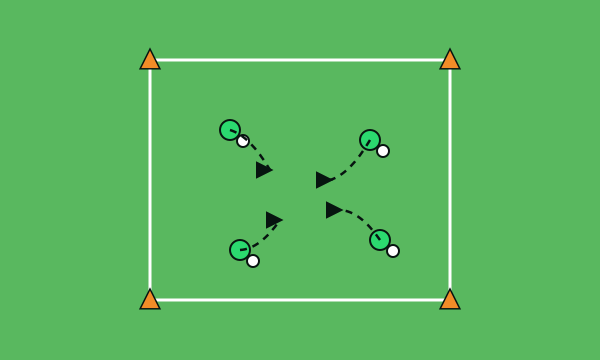 Red Light, Green Light: free dribbling inside a coned square, freezing on command.
Cone Slalom
Goal: dribbling with both feet and changing direction. Setup: lines of 5 cones in a zigzag, 1 yard apart; one line for every 2 kids. Duration: 6-8 minutes. How to play: dribble the zigzag to the end, then run back carrying the ball for the next kid in line. Easier: space cones 1.5 yards apart, either foot allowed. Harder: tighten cones to 0.75 yards apart and require a foot switch at every cone.
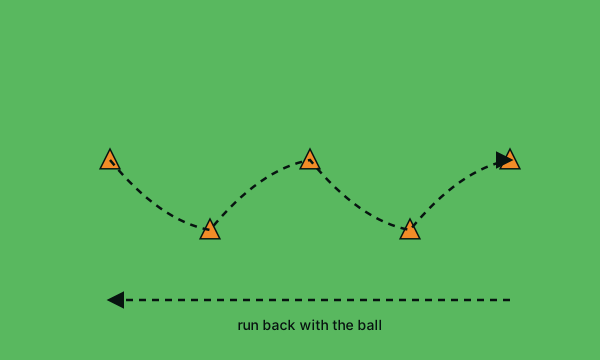 Cone Slalom: dribble the zigzag, then jog back with the ball for the next kid.
Freeze Dribble
Goal: keeping control of the ball while sharing space with other kids. Setup: a 20×20-yard area, everyone inside with their own ball. Duration: 5 minutes. How to play: free dribbling, no bumping into anyone; on the whistle, everyone stops the ball under their foot in under 2 seconds. Easier: bigger area, more time to stop. Harder: smaller area, stop within 1 second.
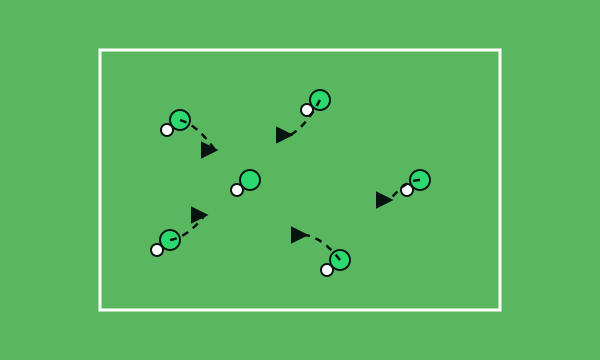 Freeze Dribble: everyone dribbles in shared space, then stops on the whistle.
Stopping and receiving games
Catch My Pass
Goal: first touch on a ball rolled along the ground. Setup: pairs (or threes if the group is odd) standing 3-4 yards apart, one ball per pair. Duration: 6-8 minutes. How to play: one kid rolls the ball to their partner, who tries to stop it with their foot before it rolls past. Easier: 2 yards apart, hands allowed to help trap it. Harder: 5-6 yards apart, foot only.
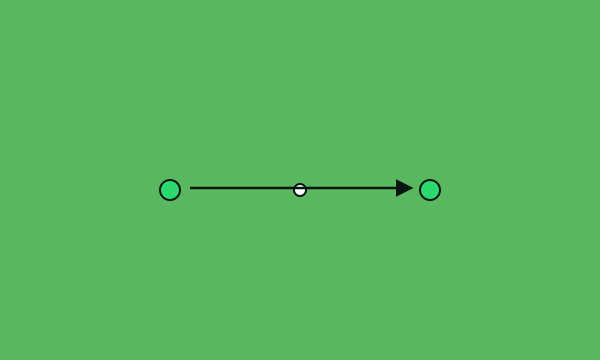 Catch My Pass: roll it to your partner, who traps it before it gets away.
Goalkeeper for a Minute
Goal: a fun, optional way to let kids try stopping the ball with their hands — not a required rotation or a real goalkeeper position at this age. Setup: a small goal or two cones 4-6 feet apart, a short line of 3-4 kids. Duration: 6 minutes, rotating goalkeepers every 60-90 seconds. How to play: each kid who wants a turn takes one in goal, saving soft shots from a teammate or coach. Easier: slower shots from closer in, wider goal. Harder: shots from farther out, narrower goal. Safety: soft shots only, close enough that nobody’s winding up for a hard kick; if you’re using a small goal rather than cones, secure it the way the manufacturer says and don’t let anyone climb on it. Before you buy a goal, new or used, search cpsc.gov for recalls and warnings.
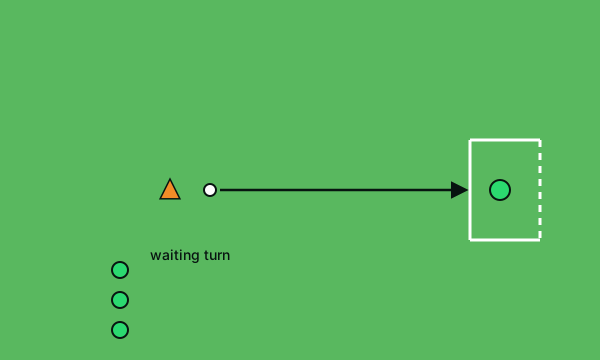 Goalkeeper for a Minute: everyone gets a short turn saving soft shots.
Shooting games
Race to the Goal
Goal: dribbling a short distance and shooting without losing control. Setup: a small goal or two cones as a goal, a starting line 6-8 yards away. Duration: 6 minutes. How to play: dribble from the start and shoot on goal once you cross a marked line. Easier: 4 yards, wider goal. Harder: 10 yards with a cone to dribble around partway there. Safety: one kid goes at a time, nobody stands behind or beside the goal in the shot’s path, and if you’re using a small goal rather than cones, secure it the way the manufacturer says and don’t let anyone climb on it.
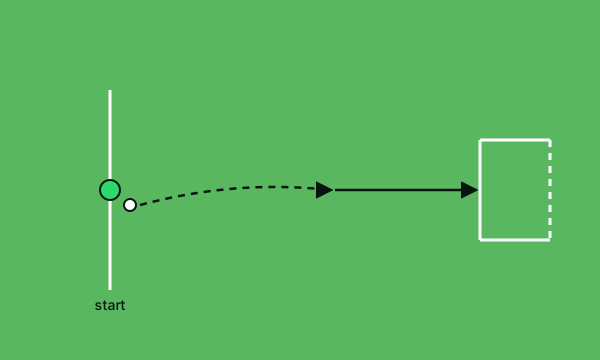 Race to the Goal: dribble in, then shoot once you cross the line.
Shooting Gates
Goal: choosing a target and controlling the direction of a shot. Setup: 3 mini-goals made of cones (“gates,” 2-3 feet wide), spread out 5 yards from the shooting spot. Duration: 6-8 minutes. How to play: each kid picks one of the 3 gates and shoots to put the ball through it. Easier: 4-foot gates, 4 yards away. Harder: 18-inch gates, 7 yards away. Safety: space the gates out so kids aren’t shooting across each other’s path.
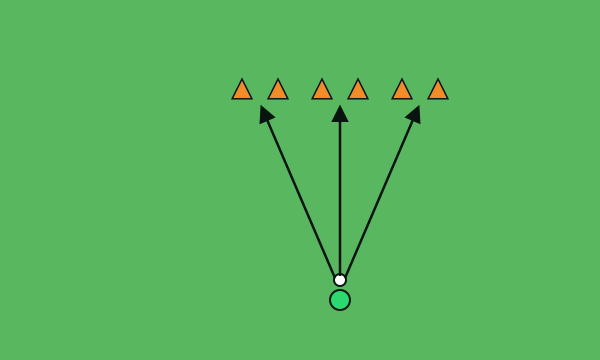 Shooting Gates: pick a gate, then shoot to put the ball through it.
1v1 and keep-your-own-ball games
These two also start building the habit that helps most with bunch ball later on: each kid getting used to having — and keeping — their own space. More on that in how to stop bunch ball.
Protect the Rock
Goal: using your body to shield your own ball, without pushing. Setup: a 10×10-yard area, one ball per kid, 1-2 kids without a ball playing “thief.” Duration: 5-6 minutes, rotating who’s the thief. How to play: kids with a ball shield it with their body while the thief tries to poke it away with a foot — no pushing or charging in. Easier: bigger area, just 1 thief. Harder: smaller area, 2-3 thieves. Safety: foot-to-ball contact only; stop the game the moment anyone starts shoving.
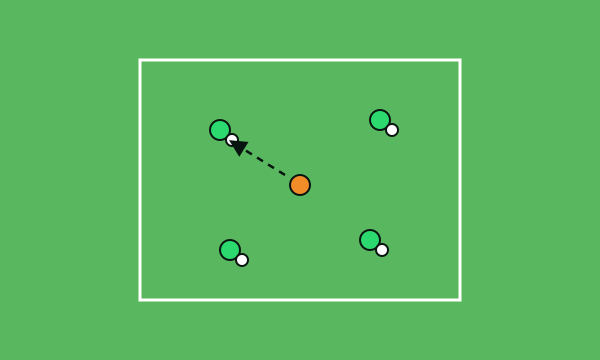 Protect the Rock: shield your ball with your body — no pushing, just footwork.
Sharks and Minnows
Goal: dribbling with your head up and reading where the open space is. Setup: a 20×15-yard area; most kids (“minnows”) line up on one end with a ball, 1-2 kids (“sharks”) without a ball start in the middle. Duration: 6-8 minutes, rotating the sharks. How to play: minnows dribble from one end to the other without a shark poking their ball away. Easier: wider area, just 1 shark. Harder: narrower area, 2-3 sharks.
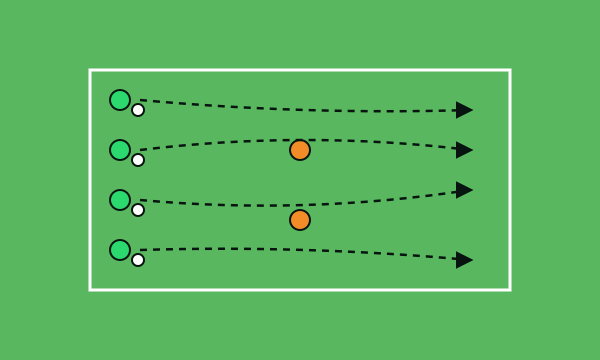 Sharks and Minnows: dribble past the sharks to the other side.
Passing and possession games, in that spirit
What I see in grassroots soccer in Spain is a lot of passing-and-possession play at this age, and a lot of practice built specifically around first touch and passing — the exact games depend on each team’s own coach, so there’s no single “Spanish drill” to hand you. These three are my own take in that spirit, simplified for 5-year-olds.
Pass the Gate
Goal: passing with the inside of the foot toward a target. Setup: pairs 4-5 yards apart with a small “gate” (2 cones, about 3 feet apart) between them, one ball per pair. Duration: 6-8 minutes. How to play: partners pass back and forth, trying to send the ball through their own gate each time; see how many gate-passes they can string together. Easier: wider gate (4 feet), closer distance (3 yards). Harder: narrower gate (18 inches), 6 yards apart.
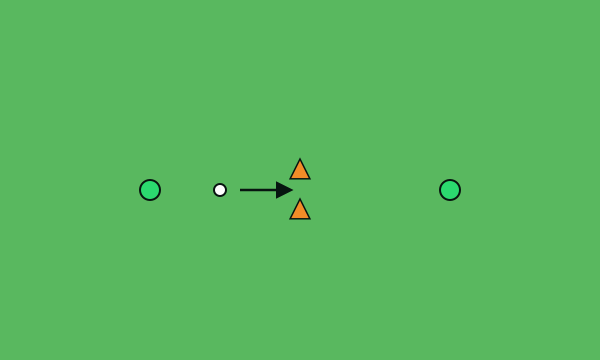 Pass the Gate: pass it to your partner, aiming through the gate.
Control and Pass
Goal: a steady rhythm of receiving and passing, not just one pass. Setup: pairs 3-4 yards apart, one ball per pair. Duration: 6 minutes. How to play: partners pass back and forth with the inside of the foot, controlling it first rather than just blocking it back, and count how many passes in a row stay under control. Easier: let the ball roll a little before they touch it again, 2 yards apart. Harder: one touch to control and a second touch to pass, 5 yards apart.
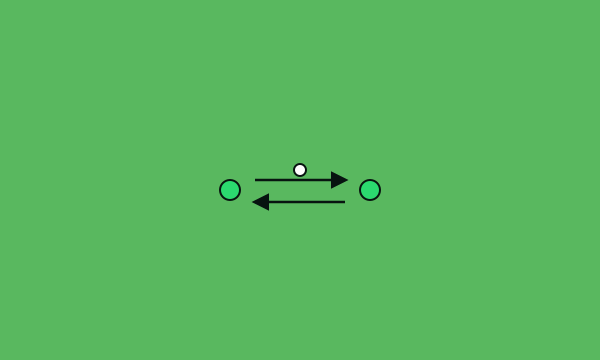 Control and Pass: receive it, control it, pass it back — and keep count.
Keep-Away with Lots of Space
Goal: keeping the ball as a group by finding space, not by running fast. Setup: a big, open 20×20-yard area (bigger than feels necessary), 3-4 kids, one ball, no defender to start. Duration: 5-6 minutes. How to play: the group passes the ball around, and everyone without the ball jogs to an open space to ask for the next pass. Add one gentle “chaser” once they’ve got the hang of it. Easier: no chaser at all, just passing and moving. Harder: a chaser who can intercept, smaller space.
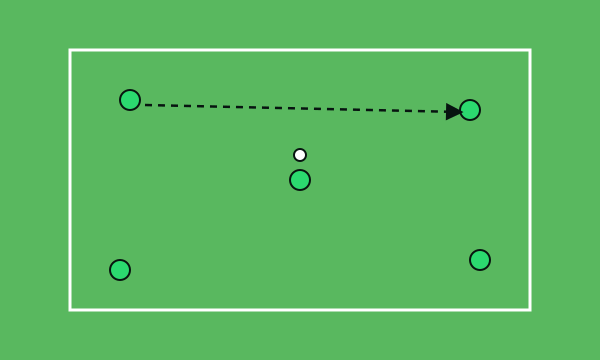 Keep-Away with Lots of Space: spread out, pass it around, and go find open space.
FAQ
How long should a drill last at this age?
Most of the games above run 5-8 minutes — long enough to get the idea, short enough that attention doesn’t wander. Plan on cycling through several in one practice rather than drilling any single one for a long stretch.
Do 5-year-olds need to learn passing yet?
Not as a requirement — U.S. Soccer’s guidance for this age is built around 1v1 and small-group play, not passing patterns. But a little passing and possession play, like the games in the last section, is a normal part of the mix in plenty of programs, and kids this age can absolutely handle a simple pass-and-receive game.
What do you do if a kid won’t share the ball?
At practice, the easiest fix is giving every kid their own ball for most of the session — there’s usually nothing to share. For the games here that do use one shared ball (Keep-Away, Sharks and Minnows), expect some kids to want it constantly; that’s normal at 5, not a discipline problem, and rotating turns quickly keeps it fair without turning it into a lecture.
Do these work as U6 soccer drills?
Yes. U.S. Soccer’s 2026 guidance puts U5 and U6 under the same rule, “No structure or tactics. Focus on enjoyment,” and the games above are built for exactly that. Not sure which age group your child plays in? Soccer age groups explained has the birth-year rule.
What comes after these?
Once a group is comfortable with the ball and ready for more passing and 2v1 play, the soccer drills for 6-year-olds are the next step.
Sources
- U.S. Soccer, Age-appropriate soccer formats for training and games (The U.S. Way, 2026): documents.ussoccer.com
- U.S. Soccer, Guide to Coaching U7s and U8s (The U.S. Way, 2026): documents.ussoccer.com

Peter D. — Peter D. is KickZone’s editor. Based in Spain and closely involved in grassroots youth soccer there, Peter turns the way Spanish kids learn the game into practical help for US parents and volunteer coaches. Rules always come straight from the official rulebooks, cited.