
How to Stop Bunch Ball in Youth Soccer: 5 Games That Work
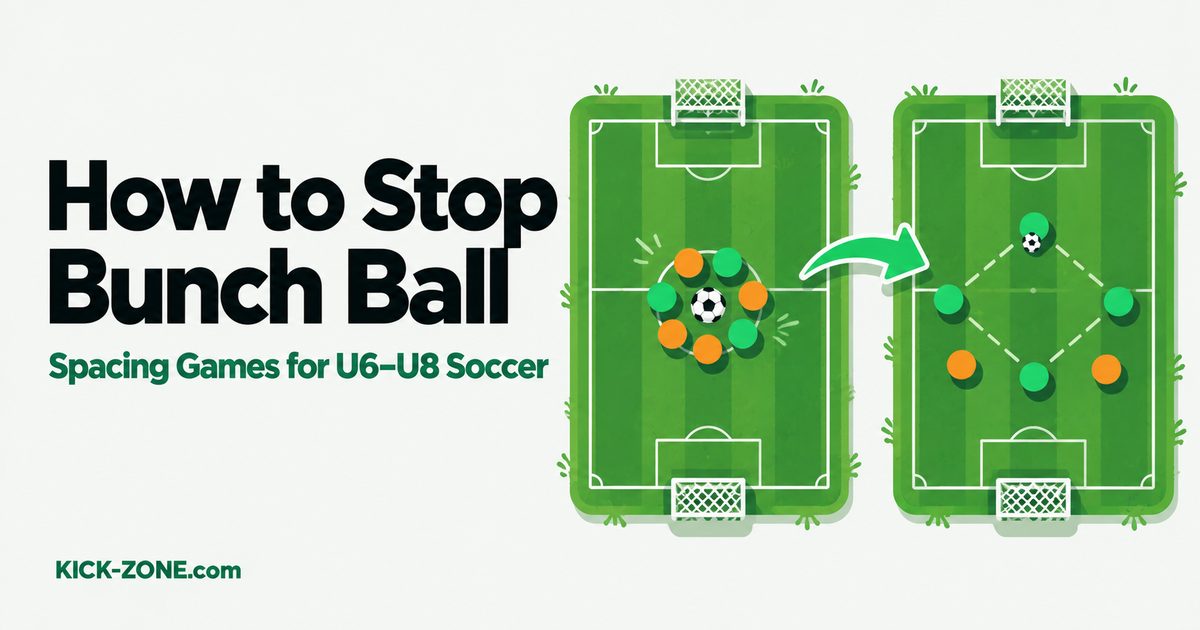
Bunch ball (the “beehive,” every kid chasing one ball) is normal at U5-U8, not a sign something’s wrong — official youth soccer guidance skips fixed positions at this age, and skips tactics entirely at U5-U6. You won’t fix it by yelling “spread out,” because young kids don’t yet understand the idea of space. What tends to help is turning space into a rule of the game itself, using constraint-based games like Freeze, Wide Channels and Protect the Rock, in that order.
Why do young kids bunch around the ball in the first place?
If you’re brand new to this age group, the first-time coach guide is the place to start; this page assumes you’ve already got a team on the field and a case of the bunch-ball blues.
Here’s the short version: it’s not a mistake you’re making, it’s just where kids this age are developmentally, and official guidance says so directly. U.S. Soccer’s 2026 player-development framework calls for “No structure or tactics. Focus on enjoyment” at U5-U6, built around small-sided games like 1v1 and 2v2 rather than a full field with roles to fill. It helps to think of it this way: at 5, 6 and 7, most kids can really only track one thing on the field at a time, and that one thing is the ball. Asking them to also hold a position and watch for teammates is asking for a skill that simply hasn’t shown up yet. Many first-time coaches assume this age needs to learn positions or structure to “fix” the swarm — but the official guidance says the opposite: there isn’t supposed to be structure yet.
By U7-U8, U.S. Soccer’s coaching guide does start introducing “attacking and defending roles in 4v4” and a reference shape (“1-2-1, no GK”) — but that’s a game model to teach from, not a permanent seating chart: the same guide lists “players to experience all positions” and asks coaches to give every player a chance to play goalkeeper (if a goalkeeper is used). The takeaway across U5-U8: rotate kids through different jobs and teach space through games, rather than locking anyone into “defender” or “forward” this early.
What doesn’t work?
Yelling “spread out!” doesn’t work — not because kids are ignoring you, but because “space” is still an abstract idea to a 5-, 6- or 7-year-old. They can’t yet picture an empty patch of grass as something useful; what they can see is the ball, right there, with their name on it. Many coaches report calling it out from the sideline for a whole season with no real change.
Teaching fixed positions doesn’t fix it either, at least not at this age: nothing in the official U5-U8 guidance calls for assigning permanent spots. U.S. Soccer’s own framework skips structure and tactics at U5-U6 and, at U7-U8, introduces roles that kids rotate through rather than fixed spots. What tends to help is building space into the game itself, so kids discover it by playing rather than by being told.
Games that can help (in this order)
These fit naturally into the scrimmage block of a normal practice — see the U6 practice plan for where that lands in a full session. Run them roughly in this order; each one builds on the last.
Freeze Game
Goal: helping kids spot the “beehive” themselves and find a pass out of it. Setup: your team’s normal small-sided format (3v3 or 4v4, no goalkeeper — whatever your league plays), on your usual practice area. Duration: built into 10-12 minutes of free play or a scrimmage. How to play: the moment 3 or more kids bunch around the ball, blow the whistle — everyone freezes exactly where they are. Ask the kid with the ball, “Can you pass to anyone?” If they can’t see it, point to the open teammate. Easier: freeze as soon as just 2-3 kids bunch up, and just give the answer yourself. Harder: let the bunch build a little longer, and ask 2-3 different kids before play restarts.
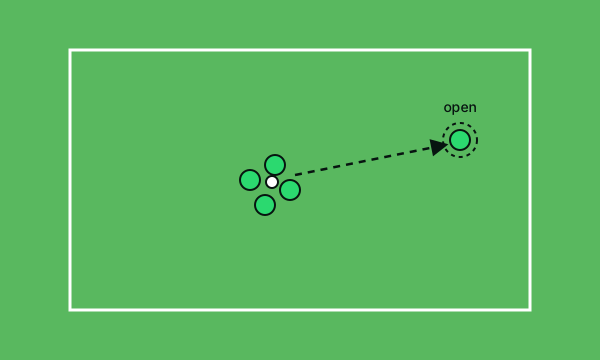 Freeze Game: stop the action, ask who’s open, and point if nobody sees it.
Wide Channel Game
Goal: discovering the space on the wings that nobody uses at this age. Setup: two 3-5-yard-wide channels marked with cones down each side of your playing area; a goal only counts if the ball touched a channel first. Duration: 8-10 minutes. How to play: play a normal scrimmage in your usual format, but a goal only counts if, somewhere in that sequence, the ball got into one of the side channels. Easier: widen the channels to 6-7 yards, and call it out loud whenever someone enters one. Harder: narrow the channels to 2-3 yards, and require the ball to arrive there from a pass, not just a dribble.
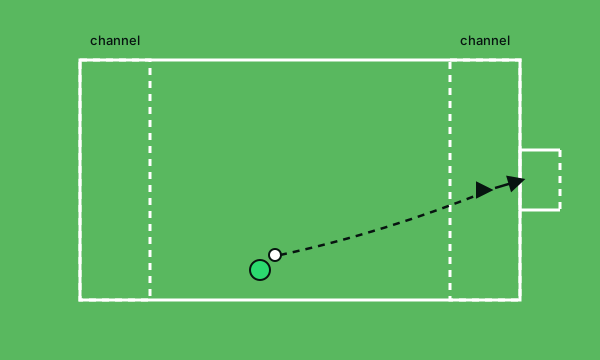 Wide Channel Game: no goal counts unless the ball visits a side channel first.
Protect the Rock
A quick warm-up here, not a new game — this is the same shielding drill from the games for 5-year-olds list. Run it for 5 minutes right before the scrimmage, so every kid practices owning their own space before the group mixes together.
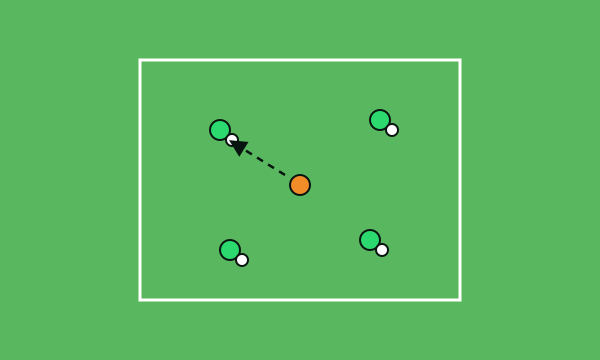 Protect the Rock, reused as a warm-up: each kid shields their own ball before the group mixes together.
Team Keep-Away
Goal: keeping the ball moving as a group and learning to open up for a pass, without a fixed opponent on top of them yet. Setup: a 15×15-yard area, one ball, the whole team inside (not divided into two sides yet), 1 rotating “defender.” Duration: 6-8 minutes, swapping the defender every 60-90 seconds. How to play: the group passes the ball around, trying to keep the defender from touching it; whoever’s pass gets touched becomes the next defender. Easier: bigger area; for younger kids, allow catching and passing with hands as a warm-up version. Harder: smaller area, 2 defenders. Safety: this is a passing game, not a tackling one — no grabbing or shoving to get the ball back. Keep an eye on pace and spacing in an area this size so kids chasing the ball don’t collide.
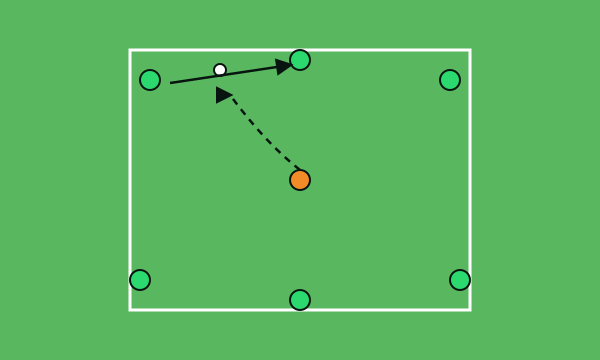 Team Keep-Away: the group keeps the ball away from one rotating defender.
Shape/Corner Game
Goal: giving kids a visual reference for “their” space, without assigning anyone a fixed position. Setup: 4 cones (different colors if you have them) marking the corners of your playing area. Duration: 5-6 minutes, as a transition before or after the scrimmage. How to play: whenever the ball goes out, or right after a goal, every kid sprints to touch the nearest corner cone before you restart play. Nobody owns a corner — anyone can go to any one. Easier: use just 2 corners, and give more time to get there. Harder: use all 4, as a mini-race to see who tags all 4 first. Safety: send kids in a couple of staggered groups, or point each one toward a different corner first, so nobody’s sprinting straight across another kid’s path.
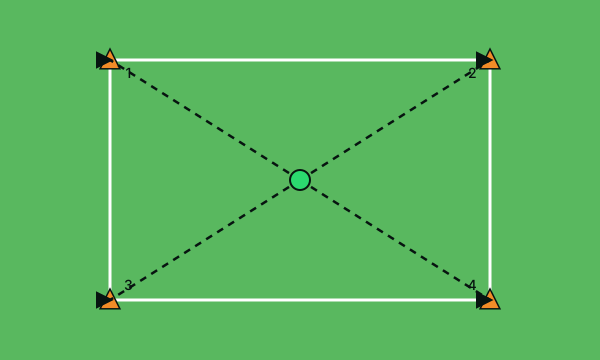 Shape/Corner Game: sprint to a corner cone — nobody owns one, so anyone can go to any corner.
A couple of safety basics carry over from any practice. Wide Channel and Team Keep-Away keep kids moving for several minutes at a stretch, so keep water breaks frequent and shorten or skip practice on hot days. And bunching up means more kids running into each other, not fewer — if a collision during any of these games leaves a child with a knock to the head, stop play right away. If there’s any suspicion of a head injury, they’re done for the day: tell the parents and your league, and follow your league’s concussion protocol and a health professional’s advice before they’re back on the field.
Does this happen in other countries, too?
What I see in grassroots soccer in Spain is that positions, spacing and passing get introduced bit by bit, over time — and matches at this age still look like a lot of swarm and chaos. If that’s reassuring: bunch ball isn’t a US-only growing pain, and it isn’t a sign your practices are behind. It’s just how young kids learn the game everywhere, and it fades gradually, not all at once.
FAQ
Is bunch ball a sign my team isn’t learning?
No. It’s a normal stage of how young kids track a game, not a sign of a coaching problem. What tends to help is the kind of constraint-based games above — not more yelling, not fixed positions, and not worrying that your team is somehow behind.
At what age does bunching usually stop on its own?
There’s no official cutoff. It fades gradually as kids get more touches on the ball and more small-sided games under their belt, and by U7-U8, official coaching guidance starts introducing attacking and defending roles kids can rotate through — a step up from “everyone, everywhere,” but still a long way from fixed positions.
Should I ever use fixed positions at U6-U8?
Nothing in the official guidance for this age calls for it. Even at U7-U8, where U.S. Soccer starts introducing roles, the point is rotation — every kid gets a turn at different jobs, including goalkeeper — not locking a 6-, 7- or 8-year-old into one spot on the field.
Sources
- U.S. Soccer, Age-appropriate soccer formats for training and games (The U.S. Way, 2026): documents.ussoccer.com
- U.S. Soccer, Guide to Coaching U7s and U8s (The U.S. Way, 2026): documents.ussoccer.com

Peter D. — Peter D. is KickZone’s editor. Based in Spain and closely involved in grassroots youth soccer there, Peter turns the way Spanish kids learn the game into practical help for US parents and volunteer coaches. Rules always come straight from the official rulebooks, cited.