
First-Time Youth Soccer Coach: Step by Step First Practice
You don’t need coaching experience to run a good first practice, though your league likely has its own registration and background-check process to complete first. Get a size-3 ball for every kid, skip lines and long talks, and confirm two things with your league before day one: the game format (most leagues play 3v3 or 4v4 with no goalkeeper at this age, but it varies) and that heading is banned at every level. Email parents first, then build 45-60 minutes around one skill and a short game at the end.
What do you need before the first practice?
Keep the gear list short. Each kid needs a size-3 ball — that’s the standard across every youth soccer organization we checked, from US Youth Soccer’s national policy to AYSO and the state associations — plus shin guards, which are required at practice and games and have to be fully covered by socks, not just taped on. Bring 20-30 cones for whatever drills you run; nothing fancier is required at U5-U8.
Before you ever set foot on the field, send parents a short email or round them up for five minutes at drop-off. AYSO’s own 6U coaching manual spends several pages on getting parents involved early, and it’s good advice beyond AYSO too: ask for a volunteer or two to help on the sideline, confirm the day and time practice lands on, and set the tone for the season — low-key, mistakes are part of learning, nobody needs gear beyond the basics above. If the week before your first practice feels more stressful than practice itself, you’re not alone; it’s one of the most common questions new volunteer coaches ask, and a two-line email answers most of it before it starts.
What safety basics do you need to lock in before day one?
A few things aren’t up for debate, regardless of what your league’s rulebook says about format or game length. Get these settled before your first whistle, not figured out mid-practice:
- No heading, ever. U.S. Soccer, AYSO and North Texas ban heading in both games and practice at this age; US Youth Soccer’s rule is mandatory in its own competitions and strongly encouraged for state and local play, and Cal South’s matrix lists heading as “NO” without distinguishing games from practice. Don’t run any heading drills, even “soft” versions with a balloon or foam ball.
- Shin guards, every practice, fully covered by socks. A shin guard poking out above the sock doesn’t meet the rule.
- Secure any goal you bring the way the manufacturer says — stakes on grass, weights on hard surfaces — and never let a kid climb or hang on one. Check it before each use. The CPSC’s guidelines on movable soccer goals are written for full-size goals, not small pop-up goals, but the same habits apply to any goal. Before you buy a goal, new or used, search cpsc.gov for recalls and warnings.
- Water with no limit, and a plan for heat. Let kids drink whenever they want — don’t ration it. On hot days, U.S. Soccer’s own heat guidance calls for more hydration breaks, a shorter practice, or moving it to a cooler time of day, rather than pushing through a fixed schedule.
- If you hear thunder, leave the field immediately. AYSO’s referee guideline is direct about it: thunder means lightning is already within striking distance, so don’t wait for rain to start, or stop, before you seek shelter. Give it a good 30 minutes with no thunder before anyone goes back out.
- If a child takes a knock to the head, stop play. If you suspect a head injury, keep them out for the rest of the day — even if they say they’re fine — tell their parents and your league contact, and follow your league’s concussion protocol and a health professional’s advice. That’s deliberately cautious: your league’s protocol has the final word.
None of this takes special equipment or training to get right. It just has to be decided before the first practice, not during it.
What rules does your league decide (and what’s the same everywhere)?
Beyond those non-negotiables, a lot changes depending on your league. National organizations set a baseline, but state associations and local leagues can and do change the details — your own league’s handbook has the final word.
| What | What’s the same everywhere | What your league decides |
|---|---|---|
| Format | No goalkeeper in in-house recreational play at U5-U8 | 3v3 or 4v4 is most common at U6 — US Youth Soccer recommends 3, AYSO plays 4-a-side, North Texas allows either. U.S. Soccer’s 2026 guidance goes further, favoring unstructured 1v1 and 2v2 play over any fixed format at U5-U6, and “up to 4v4” at U7-U8. Florida’s recreational travel division is an exception at 8U, playing 7v7 with a goalkeeper |
| Game length | — | Anywhere from four 6-minute quarters (US Youth Soccer at 6U) to two 20-minute halves (AYSO at U7-U8) — there’s no single standard |
| Who referees | — | A certified youth referee, a parent or coach, or nobody at all, depending on the league (North Texas, for example, allows a parent or coach to referee 8U and younger) |
| Heading, shin guards, ball size | Banned / required / size 3 — see the safety basics above | Not up to the league |
For the full breakdown of what’s fixed nationally versus what your own league sets, see U6 soccer rules and U8 soccer rules. If you only confirm one thing before day one, make it the game format for your actual age group — it’s what tells you what to practice.
What’s the “no lines, no laps, no lectures” rule?
You’ll hear some version of “no lines, no laps, no lectures” from experienced volunteer coaches, and it holds up well against the official guidance. Keep any explanation under two minutes, and give every kid their own ball whenever the drill allows it, instead of lining kids up to take turns. A kid standing in line touches the ball a handful of times in twenty minutes; a kid with their own ball touches it constantly — and at this age, touches are most of the curriculum.
This isn’t just a style preference. U.S. Soccer’s 2026 player-development framework is explicit that U5-U6 training should have “no structure or tactics” and focus on enjoyment, built around tiny-sided games like 1v1 and 2v2 rather than drills that have kids waiting their turn. By U7-U8, the federation’s coaching guide starts introducing attacking and defending roles and a reference shape (a “1-2-1,” no goalkeeper) — but it’s framed as a game model to rotate through, with every kid getting a turn at every job, including goalkeeper, not a permanent lineup.
What should your first practice look like, minute by minute?
A simple structure gets you through 45-60 minutes without over-planning: a short warm-up where every kid has their own ball (about 10-12 minutes), one technical skill for the day worked through a couple of games (15-20 minutes), a water break, and a small-sided scrimmage to close it out (15-20 minutes).
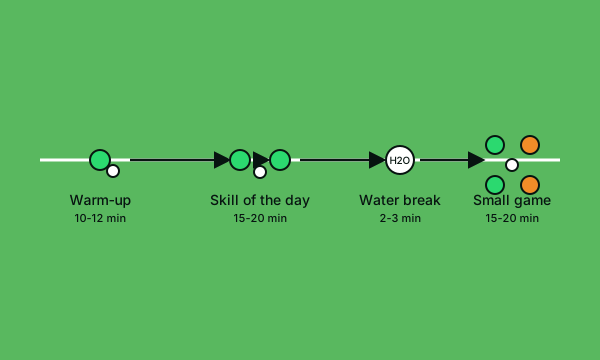 A first practice, start to finish: warm-up, one skill, a water break, then a small game.
The full U6 practice plan walks through that structure minute by minute, with diagrams and a free printable, and the bank of drills for 5-year-olds gives you more games than you’ll need for any single practice, grouped by what each one teaches. Coaching an older 7- or 8-year-old team instead? The U8 practice plan and the U8 soccer drills are built the same way.
My team turns into a scrum around the ball — is that normal?
Completely. If your practice or your first few games look like a swarm of kids chasing one ball — sometimes called “bunch ball” — that’s not a sign anything’s wrong. It’s exactly what the official guidance above predicts: nobody’s taught positions yet, and a 5- or 6-year-old can really only track one thing on the field at a time, which is the ball. It fades gradually, not overnight, and how to stop bunch ball has a short list of games that speed that up without lectures about “spreading out.”
What if a kid gets hurt, won’t listen, or won’t play?
Most scrapes are minor — a fall, a kicked shin, a bruised ego — but take any worrying injury seriously and get it checked rather than assuming it’s nothing. Patience and short, predictable routines handle the everyday bumps: a consistent warm-up, the same signal for “everybody freeze,” and not overreacting to a kid who sits out for a few minutes.
A real head injury is different, and it’s covered in the safety basics above: stop play, the child is done for the day, and your league’s concussion protocol and a health professional — not you — decide when they’re ready to return.
For a kid who won’t listen or won’t play, that’s normal too, especially early in the season. Keep instructions short, give them a small job (holding a cone, standing “goalie” for a few minutes even if your format doesn’t use one), and don’t expect a 5- or 6-year-old to self-regulate the way an older kid might. If it’s a pattern rather than a rough day, loop the parent in — not as a complaint, just as information they can use at home.
How does a first practice look in other countries?
What I see in grassroots soccer in Spain is that most kids start organized play before age 5, so by the time they’re 5 or 6, clubs already know them and often group them by ability level. That part doesn’t translate directly to a US recreational league — AYSO, for example, explicitly forms new teams “as evenly balanced as possible” every year, not by skill group, and most rec leagues work the same way.
What does translate is the first-day parent meeting. In the clubs I follow, that first gathering covers how the season will run, the club’s approach to training kids this age, and — maybe most usefully — a direct effort to lower expectations, because many parents arrive convinced they have the next star. Whatever your league’s format turns out to be, a few honest minutes with parents on day one does the same job here.
FAQ
Do I need experience or a license to coach rec soccer at this age?
Most rec programs don’t require coaching experience, but leagues commonly require volunteers to register and pass a background check. North Texas, for example, requires every coach, assistant coach and manager to register each year and complete an adult criminal background check (p55). U.S. Soccer’s 2017 4v4 guidance also recommended that coaches hold the age-appropriate license (p14). Check what your league requires.
How many kids is too many for one volunteer coach?
There’s no official rule, but rosters at this age typically run roughly 4 to 12 players depending on the league. A second adult on the sideline tends to matter less for the drills themselves and more for keeping an eye on everyone at once once you’re past 8 or so. If your team is on the larger side, the parent email is the place to ask for a regular helper.
What do I actually say in my first email to parents?
Keep it short: practice day, time and location; what to bring (water, a size-3 ball, shin guards, cleats if your league uses them); a request for a volunteer or two on the sideline; and a line setting the tone for the season — something like “the goal this year is fun and touches on the ball, not results.” That’s enough to start.
Sources
- US Youth Soccer, Policy on Players and Playing Rules (as of June 23, 2026): usyouthsoccer.org
- AYSO, Referee Guideline 2026-2027: wiki.ayso.org
- AYSO, 6U Kickstart Program Manual: wiki.ayso.org
- North Texas Soccer, Bylaws and Rules 2026/27: ntxsoccer.org
- Cal South, 2026-27 PDI Matrix: calsouth.com
- U.S. Soccer, Age-appropriate soccer formats for training and games (The U.S. Way, 2026): documents.ussoccer.com
- U.S. Soccer, Guide to Coaching U7s and U8s (The U.S. Way, 2026): documents.ussoccer.com
- U.S. Soccer Federation (hosted by US Youth Soccer), Player Development Initiatives (2017): usyouthsoccer.org
- U.S. Soccer, Heat Guidelines (Recognize to Recover): folsomlakesurf.org
- U.S. Consumer Product Safety Commission, Guidelines for Movable Soccer Goals: cpsc.gov

Peter D. — Peter D. is KickZone’s editor. Based in Spain and closely involved in grassroots youth soccer there, Peter turns the way Spanish kids learn the game into practical help for US parents and volunteer coaches. Rules always come straight from the official rulebooks, cited.