
U8 Soccer Practice Plan: Free 60-Minute Plan (Printable)
A U8 practice works well at about 60 minutes, built Play-Practice-Play: kids start playing small games as they arrive, spend about 18 minutes on one skill through game-like activities, and finish with a 4v4 game. That structure is what U.S. Soccer teaches in its grassroots courses, and 60 minutes is the length of Massachusetts Youth Soccer’s U8 session plans. Below: a suggested minute-by-minute plan, diagrams and a free one-page printable.
New to coaching? Start with the first-time coach guide. Coaching a younger team? The U6 practice plan is built for them.
How long should U8 practice be, and how is the time split?
No national rule sets it. Massachusetts Youth Soccer, a US Youth Soccer state association, publishes free U8 session plans that each run 60 minutes: a first play phase, a practice phase and a final 4v4 game. Its Survival Guide: 4v4 (U8) gives “1 day a week with 30 minutes of training followed by 30 minutes of game play” as an example schedule. For comparison, AYSO’s Kickstart program for 5- and 6-year-olds caps a session at “1 hour maximum, includes organizing time and breaks.”
Here’s the split this plan suggests:
| Minutes | Block | What happens |
|---|---|---|
| 0-15 | Play 1: arrival games | Small games that start as soon as two kids arrive and grow as more show up (1v1, 2v1, 2v2, 3v3), with hardly any instructions |
| 15-17 | Water | A real pause while you reset the field |
| 17-35 | Practice: skill of the day | Two games on one theme, in short rounds |
| 35-37 | Water | A real pause |
| 37-57 | Play 2: the 4v4 game | Two halves with a water break, roles rotating, very few words from you |
| 57-60 | Wrap-up | One question, then cones picked up as a game |
This timing is KickZone’s suggested adaptation, not a league requirement. Adjust it for the weather and your players. U.S. Soccer’s U7-U8 guide asks coaches to “Introduce basic routines and practice structure” and “Use regular short breaks,” and the same shape every week does both.
What safety rules apply to the whole session?
- No heading, with any ball, in any game. U.S. Soccer’s U7-U8 guide says “No heading in practice or games.”
- Shin guards on at every practice. AYSO requires them fully covered by socks, which is good practice anywhere; check your league’s equipment rule.
- Water whenever a child asks, not only in the breaks. On hot days, U.S. Soccer’s heat guidance calls for more water breaks, a shorter practice or postponing to a cooler time. Treat 60 minutes as a ceiling, not a target. Exertional heat stroke is a medical emergency: call 911.
- Thunder: stop and get everyone to shelter right away, before anyone collects cones or balls. AYSO’s guidance is to wait 30 minutes after the last thunder, or for the official all-clear; follow your league’s or facility’s policy.
- A knock to the head: stop play. If a head injury is suspected, the child sits out the rest of the day, even if they say they feel fine. That’s our own rule, on the cautious side. Tell the family and your league, follow the league’s concussion protocol, and get a health professional’s OK before they play again.
- Drop-off and pickup: follow your league’s supervision policy. AYSO’s Safe Haven rules say “No child shall be left unsupervised after a match or practice,” and that no volunteer should be alone with a child, so plan for a second adult at arrival and pickup.
What do you set up before kids arrive?
Massachusetts’ guide suggests arriving “at least 15 minutes early,” walking the field to check for holes or debris (and moving your field away from anything you can’t fix), and setting up “backwards”: your last activity first, in a different cone color, so you can switch without stopping. Have spare balls ready and put water bottles close to where kids play.
For the 4v4 at the end you need 2 small goals, one at each end, plus 2 more only if you run two arrival fields. Cone goals are the simplest. Pop-up goals get installed and secured the way the manufacturer says and your facility allows (on artificial turf, stakes may not be an option), checked before use, and nobody climbs or hangs on them. The CPSC’s guidelines on movable soccer goals are written for full-size goals, but the same habits apply. Before you buy a goal, new or used, search cpsc.gov for recalls and warnings.
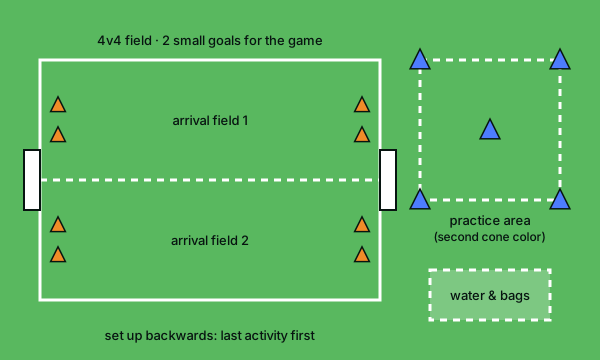 Set up backwards: game field first, practice area in a second cone color, water well away from the play.
Play 1: what do kids do as they arrive (minutes 0-15)?
As soon as two kids arrive, start a 1v1 on a small field, about half your game field, with two small goals or cone gates. As more kids show up, it becomes 2v1, 2v2, then 3v3. Uneven teams are fine: U.S. Soccer’s format chart says “Training games at all age groups should include unbalanced teams (2v1, 3v2 etc).” Massachusetts’ U8 plans open the same way, and U.S. Soccer’s Play-Practice-Play explainer describes these as “pickup-style games” led by the players. Roll a new ball in whenever one goes out.
A kid waiting for a partner can do Ball Mastery Countdown on the side.
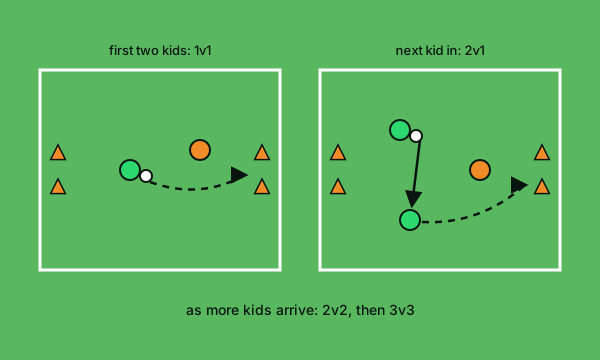 Arrival games: 1v1 becomes 2v1, 2v2 and 3v3 as kids show up.
Practice: what’s the skill of the day (minutes 17-35)?
Pick one theme and two games from the U8 drill bank that work it, in short rounds. Massachusetts’ guide notes kids this age take in “only 1-3 concepts at a time” and stay more focused with “10-12 (1-minute rounds)” than with one long game. Treat both as rules of thumb.
| Theme | Game 1 | Game 2 |
|---|---|---|
| Passing and receiving (week 1) | Passing Triangles | Target Player 2v2 |
| Dribbling and speed | Color Gates Dash | Go and Guard 2v2 (attacking side) |
| Shooting | Touch and Shoot | 4v3 With a Joker |
| Winning the ball back | Go and Guard 2v2 | 4v3 With a Joker (the team of 3 defends) |
| Movement (low-energy days) | Skip, Hop and Catch | Ball Mastery Countdown |
For younger U7s, swap in games from the drills for 6-year-olds.
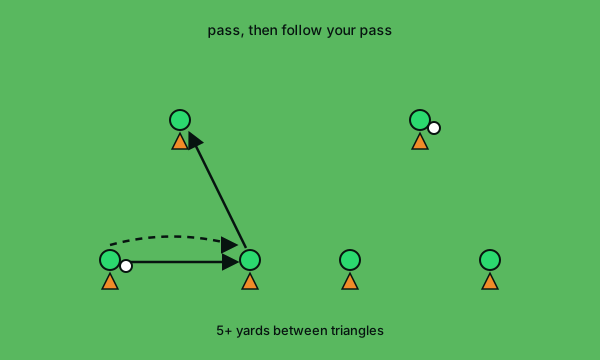 Week 1 example: Passing Triangles, from the U8 drill bank.
Play 2: how do you run the 4v4 game (minutes 37-57)?
End with the real game. In US recreational in-house soccer, U8 is usually 4v4 with no goalkeepers (AYSO, North Texas and Florida’s in-house rules all say so) on a field of about 25-35 by 15-25 yards. Some travel teams play differently: Florida’s 8U travel and competitive teams play 7v7 with a goalkeeper. U8 soccer rules has the details by league.
Play two halves of about 9 minutes with a water break. Each half, give kids a different spot in the 1-2-1 diamond; over several practices, everyone tries all four, as in 4v4 Diamond Rotation. U.S. Soccer’s U7-U8 guide puts it simply: “Players to experience all positions.”
Explain the game in about 30 seconds (Massachusetts’ guide calls it PEP: “picture,” “explain,” “play”), then let them play. U.S. Soccer’s Play-Practice-Play article says the coach should “observe and guide using minimal dialogue if possible.” Keep spare balls by the field so a new one goes in as soon as one goes out. If the game turns into one big swarm, see how to stop bunch ball.
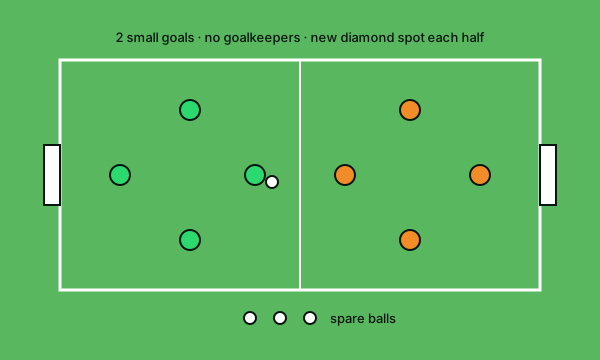 The 4v4 game: two small goals, no goalkeepers, a new diamond spot each half.
How do you wrap up (minutes 57-60)?
Ask one simple question, like the one Massachusetts’ guide suggests: “What did you enjoy about the activity?” Then turn cone pickup into a game: everyone brings back one cone of the color you call. Say goodbye to each kid, and make sure every child leaves with their own grown-up.
How does a session at this age look in Spain?
What I see in grassroots soccer in Spain is that kids of 7 and 8 train twice a week for an hour, plus the weekend game, which lines up with the 60 minutes above. Sessions there open with ball exercises that double as the warm-up: some dribbling, some passing, a few shots. That’s a good swap for the arrival games on days when your whole team shows up at once. In the clubs I follow, kids this age also still play a futsal-style format with four players and a goalkeeper; US rec U8 is usually 4v4 without one, so play what your league plays.
Free printable: your U8 practice plan, one page
Print it once and reuse it every week, filling in the blanks by hand. For a blank version that works at any age, with room to sketch each setup, see the soccer practice plan template.
| Block | Minutes | Game(s) | Equipment | Goal |
|---|---|---|---|---|
| Arrival play | 15 | 1v1 to 3v3 as kids arrive | 2 small fields, small goals or cones, spare balls | Play right away |
| Water | 2 | — | Water for every kid | A real pause |
| Skill of the day | 18 | Skill: ___ · Game 1: ___ · Game 2: ___ | Depends on the games | One theme, short rounds |
| Water | 2 | — | Water for every kid | A real pause |
| 4v4 game | 20 | 4v4, no goalkeepers, two halves; rotate roles | Pinnies, 2 small goals (one at each end), spare balls | Let them play |
| Wrap-up | 3 | “What did you enjoy today?” | — | Kids pick up the cones |
The printable also carries a “Before you start” checklist (walk the field, goals secured, last activity set up first, spare balls), the rules that never change (no heading; shin guards on, covered by socks; water any time; thunder means shelter now) and a box to write down your league’s answers: game format, game length, who referees, throw-in, pass-in, kick-in or dribble-in, and whether there are goalkeepers.
Download the free printable U8 practice plan (PDF)
FAQ
How often should a U8 team practice?
There’s no national rule; your league sets the schedule. Massachusetts’ guide gives one day a week, with 30 minutes of training and 30 of game play, as an example. In the clubs I follow in Spain, kids this age train twice a week for an hour, plus a weekend game.
What if only 4 kids show up?
Play 2v2 instead of 4v4 and lean on the games where everyone has a ball. Fewer kids means more touches each, so the plan still works.
Do U8 players need a goalkeeper at practice?
Most US rec U8 plays without one. If your league uses goalkeepers, U.S. Soccer’s U7-U8 guide asks coaches to “provide opportunities for all players to play as goalkeeper (if a GK is used),” so rotate. For a goalkeeping game without diving, see Goalie Wars.
Sources
- Massachusetts Youth Soccer, U8 4v4 session plan, week 1: mayouthsoccer.org
- Massachusetts Youth Soccer, Survival Guide: 4v4 (U8): mayouthsoccer.org
- Massachusetts Youth Soccer, Session Plans: mayouthsoccer.org
- U.S. Soccer, “Five Things to Know About Play-Practice-Play” (2018): ussoccer.com
- U.S. Soccer, Guide to Coaching U7s and U8s (The U.S. Way, 2026): documents.ussoccer.com
- U.S. Soccer, Age-appropriate soccer formats for training and games (The U.S. Way, 2026): documents.ussoccer.com
- AYSO, 6U Kickstart Program Manual: wiki.ayso.org
- AYSO, Referee Guideline 2026-2027: wiki.ayso.org
- AYSO, Safe Haven Policies (AYSO wiki, accessed October 2026): wiki.ayso.org
- North Texas Soccer, Bylaws and Rules 2026/27: ntxsoccer.org
- Florida Youth Soccer (FYSA), Rules (last modified August 2026): fysa.com
- U.S. Soccer, Heat Guidelines (Recognize to Recover): folsomlakesurf.org
- U.S. Consumer Product Safety Commission, Guidelines for Movable Soccer Goals: cpsc.gov

Peter D. — Peter D. is KickZone’s editor. Based in Spain and closely involved in grassroots youth soccer there, Peter turns the way Spanish kids learn the game into practical help for US parents and volunteer coaches. Rules always come straight from the official rulebooks, cited.