
U8 Soccer Drills: 10 Games for 7- and 8-Year-Olds
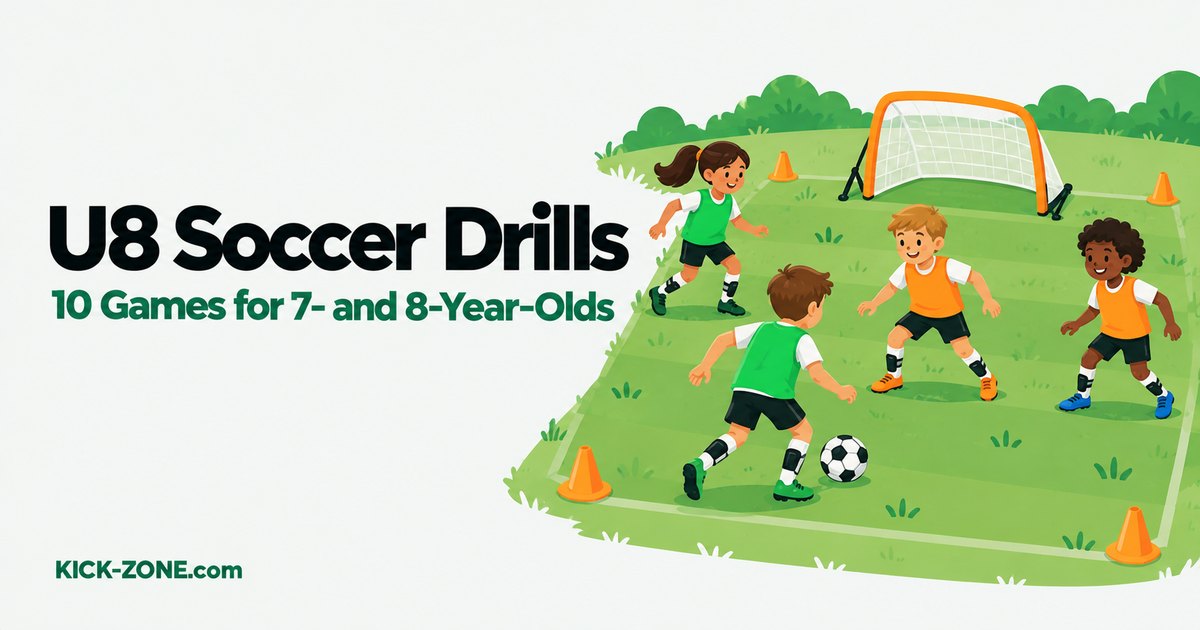
The best U8 soccer drills for 7- and 8-year-olds follow U.S. Soccer’s own U7-U8 guide: skills with both feet, short passing and receiving, shooting, winning the ball back, basic movement skills, and small games up to 4v4 where every kid tries every role. Here are 10 games organized the way the guide is, each with setup, time, an easier and a harder version, a safety note and a diagram.
New to coaching? Start with the first-time coach guide. Younger kids on the team may be happier with the drills for 6-year-olds.
Is my 7- or 8-year-old playing U8?
Start with your league’s division, not the birthday. AYSO groups two birth years together: its 8U covers kids born August 1, 2018 through July 31, 2020, and its 10U the two years before that. At these ages, US Youth Soccer’s national policy defines 6U, 8U and 10U, with no separate 7U or 9U, though state associations can vary it; Cal South, for one, lists single years. North Texas still uses December 31, so check its registration page.
By single-year age grouping in the August 1 leagues (2026-27), a 7-year-old who turned 7 before August 1, 2026 would be U8, and one who turned 7 on or after that date would be U7. An 8-year-old who turned 8 before August 1, 2026 would be U9, which in AYSO means 10U. The age group calculator does the math, and U8 soccer rules covers the game format.
If your 8-year-old already plays U9 or 10U, games get bigger: U.S. Soccer’s 2026 formats go “up to 7v7” at U9-U10, and AYSO plays U9 and U10 at 7-a-side with a size 4 ball and goalkeeper rules of their own. These games still work at practice. Check your league for match day.
What should U8 soccer drills focus on?
U.S. Soccer’s U7-U8 guide splits what to coach into four blocks. Each game below hangs off one of them:
| Block | What the guide says | Games |
|---|---|---|
| Body | “Fundamental movement skills: running; skipping; hopping; jumping and landing; leaping; throwing and catching” · “Reaction speed and acceleration” | 1, 2 |
| Ball | “Fundamental soccer skills with both feet” · “Introduce short passing and receiving” · “Shooting from 5-10 yards” · “Introduce defending skills and winning the ball back” | 3-7 |
| Small-Sided Games | “U7/U8 small-sided games: 1v1, 2v1, 2v2, 3v2, 3v3, 4v3, 4v4” · “Encourage teamwork and co-operation” · “Players to experience all positions” | 8-10 |
| Tactics | “How to play 4v4 using a game model” · “Attacking and defending roles in 4v4” · “4v4 formations: 1-2-1 (no GK)” | 10 |
The same guide’s “How to Coach” side is worth keeping in your pocket: “Keep instructions short,” “Use simple words and phrases,” “Use positive and specific praise,” “Use regular short breaks,” “Encourage players to be creative and make decisions,” “Provide individual player challenges” and “Find different ways to include all players in each activity.” Massachusetts Youth Soccer, a US Youth Soccer state association, adds two practical notes in its Survival Guide: 4v4 (U8): kids this age take in “only 1-3 concepts at a time,” and in a 15-minute activity they stay focused better with “10-12 (1-minute rounds)” than with one long game. Treat both as rules of thumb, not limits.
Don’t run all ten in one practice. Pick a few, alternate games where everyone has a ball with small-sided ones, and always finish by playing.
What safety rules apply to every game?
- No heading, in any form. U.S. Soccer’s U7-U8 guide says “No heading in practice or games,” and AYSO, North Texas and Florida rule it out at these ages too.
- Nobody in the path of a shot, including behind or beside the goal.
- Foot to ball only: no pushing, holding or sliding tackles. Shielding the ball never means charging into someone. Stop the game if anyone falls.
- Goals: cones are simplest. Pop-up goals get installed and secured the way the manufacturer says and your facility allows, checked before use, and nobody climbs or hangs on them. The CPSC’s guidelines are written for full-size goals, but the same habits apply. Before you buy a goal, new or used, search cpsc.gov for recalls and warnings.
- Heat: water with no limit. On hot days, U.S. Soccer’s heat guidance calls for more water breaks, a shorter practice or a cooler time. Exertional heat stroke is a medical emergency: call 911.
- Thunder: stop and get everyone to shelter right away, before picking up any gear. AYSO’s guidance is to wait 30 minutes after the last thunder, or for the official all-clear; follow your league’s or facility’s policy.
- A knock to the head: stop play. If a head injury is suspected, the child sits out the rest of the day, even if they say they feel fine. That’s our own rule, on the cautious side. Tell the family and your league, follow the league’s concussion protocol, and get a health professional’s OK before they play again.
Body: movement and reaction games
Skip, Hop and Catch
Goal: moving well and throwing and catching, straight from the guide’s Body block. Setup: a 20×20-yard square with 8-10 flat disc cones as “puddles.” Each kid holds their ball, and everyone travels around the square in the same direction. Duration: 5-6 minutes, in rounds of 45-60 seconds, then back to the ball at their feet. How to play: call “Skip!”, “Hop on one foot!”, “Leap over a puddle!”, “Jump and land!” (on two feet) or “Toss and catch!” with a low toss. Finish in pairs with underhand throws. Easier: running and hopping only, very low tosses. Harder: skip while tossing and catching, clap before the catch, or partners throwing from 3-4 yards. Safety: flat discs only, never hurdles or tall cones. Land on two feet, throw low and underhand, keep everyone moving the same way, and use grass.
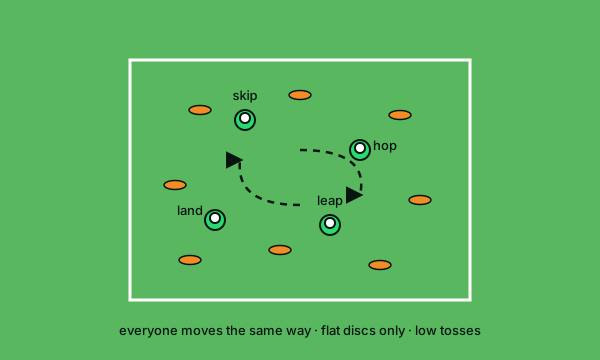 Skip, Hop and Catch: movement first, then straight back to the ball at their feet.
Color Gates Dash
Goal: reacting and accelerating with the ball (“Reaction speed and acceleration”). Setup: a 10×10-yard square in the middle, with 4 gates 2 yards wide set 8-10 yards out, one per side, each a different color. Use two gates per color if you have more than 8 kids. One ball per kid. Duration: 6 minutes, in rounds of 45-60 seconds. How to play: everyone dribbles in the middle. Call a color, and each kid speeds out through a gate of that color, loops back around the outside of that same gate’s cones, and returns to the middle. Each kid tries to beat their own time. Easier: point as well as call; jog instead of sprint. Harder: hold up a colored pinnie without saying anything, so heads have to come up; two colors in a row; weaker foot. Safety: one-way traffic. Out through the gate, back along that gate’s own return lane, never across another gate’s exit.
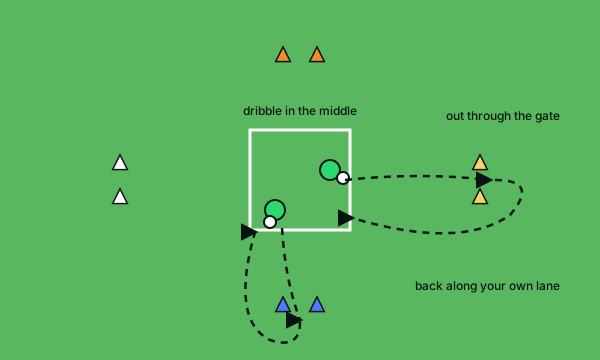 Color Gates Dash: out through the called color, back along your own lane.
Ball: dribbling, passing, shooting and defending games
Ball Mastery Countdown
Goal: lots of touches with both feet (“Fundamental soccer skills with both feet”). Setup: each kid with a ball and 2-3 yards of space around them, inside a 20×20 square. Duration: 5 minutes: 6-8 bursts of 20-30 seconds with 20 seconds of rest. Keep it short. How to play: show a move and count down: toe taps (light alternating touches on top of the ball with the sole), inside-inside, sole rolls, pull-push. Each kid counts and tries to beat their own number, one burst per foot. Easier: slower, restarting whenever the ball gets away. Harder: two moves chained, or heads up, counting the fingers you hold up. Safety: light touches on top of the ball, never stomping on it, and keep the spacing.
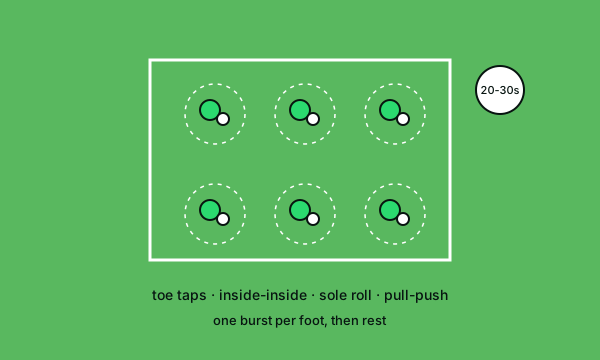 Ball Mastery Countdown: short bursts, both feet, beat your own number.
Passing Triangles
Goal: short passing and receiving (“Introduce short passing and receiving”). Setup: triangles of 3 cones 6-8 yards apart, with 3 kids and one ball per triangle and at least 5 yards between triangles, so no passing lines cross. Duration: 8 minutes, in 90-second rounds; change direction each round. How to play: pass to the next cone and follow your pass. Control, then pass, and count passes per round. Easier: pass and stay; cones 5 yards apart. Harder: receive with the far foot to open up toward the next cone, or one-touch passes for a round, or four kids in a square. Safety: ground passes, look before you pass, and never cut through a neighboring triangle.
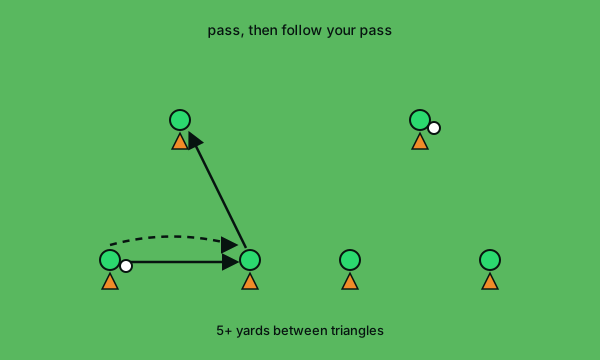 Passing Triangles: pass, follow your pass, keep it on the ground.
Touch and Shoot
Goal: receiving and shooting. The guide’s own example is “Shooting from 5-10 yards.” Setup: one small goal for every 3 kids, either 2 cones 4 yards apart or a secured pop-up. Mark a shooting zone between 5 and 10 yards out. The passer stands off to the side, out of the shooting line, and the next shooter waits by the start cone, away from it too. Keep a few balls per goal. Duration: 8 minutes. Rotate passer, shooter and next shooter every shot or two, so nobody waits long. How to play: the passer rolls a ground pass from the side. The shooter takes a touch into the zone and shoots from inside it. No goalkeeper. Balls get collected only when the coach says “go.” Easier: shoot a still ball from 5 yards at a wider goal. Harder: weaker foot, from 10 yards, or a first touch around a cone. Safety: one shooter per goal and no goalkeeper. Passer and waiting kids stay out of every shot line, including behind the goal, and retrieve only on the coach’s signal.
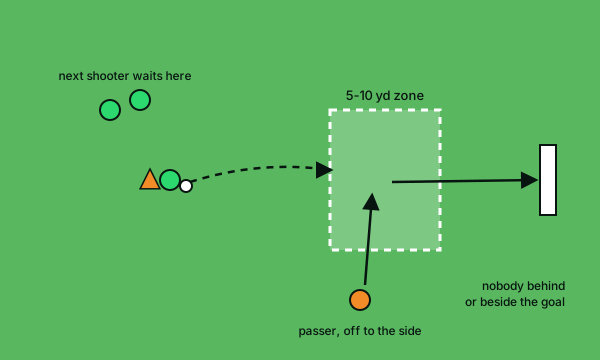 Touch and Shoot: pass from the side, touch into the zone, shoot. One shooter at a time.
Restart Partners (throw-in, pass-in, dribble-in or kick-in)
Goal: practicing the restart your league actually uses. AYSO’s referee guideline says “For U8, each Region shall have the discretion to use either throw-ins, pass-ins or dribble-ins to restart play,” and that “Training in throw-in technique may begin at U8 and up.” North Texas lets 8U and younger retake a bad throw or use a kick-in. Setup: pairs 4-5 yards apart along a line, one ball per pair, at least 5 yards between pairs. Duration: 5 minutes. How to play: for a throw-in, AYSO’s guideline says the thrower must “face the field of play; have part of each foot touching the ground either on or behind the touchline and use both hands to deliver the ball from behind, and over the head.” Throw to your partner’s feet; they control it and pass back. Swap after 5. If your league uses pass-ins or kick-ins, pass it in along the ground; for dribble-ins, dribble it in. Easier: 3 yards apart, and a bounce is fine. Harder: the partner moves and calls for it. Safety: always to the feet, never at anyone’s face, with space between pairs.
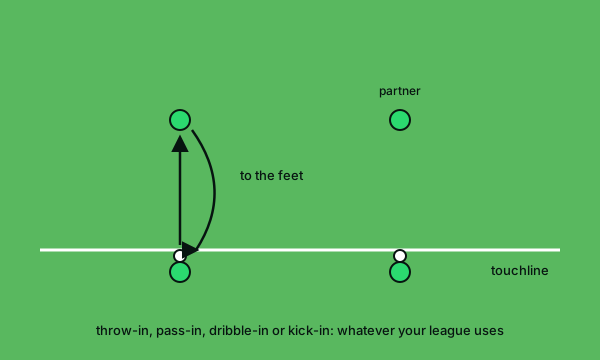 Restart Partners: practice whichever restart your league uses.
Go and Guard 2v2
Goal: defending as a pair and winning the ball back (“Introduce defending skills and winning the ball back”). Massachusetts Youth Soccer’s U8 guide sums up the job of the team without the ball as “protect the goal (get between the ball and the goal) and steal the ball.” Setup: 15×20 yards, with two 2-yard gates at each end, pinnies and spare balls. Duration: 8 minutes, in 2-minute rounds with a minute for water. How to play: 2v2. Score by dribbling through either of the other team’s gates. Without the ball, the rule is “one goes, one guards”: one defender steps to the ball, and the other gets between the ball and the nearest gate. Win it, and you attack. Easier: one wider gate at each end. Harder: a goal only counts with a pass through a gate to a teammate, or play 3v3. Safety: no pushing, holding or sliding tackles; stop if anyone falls; pair kids of similar size.
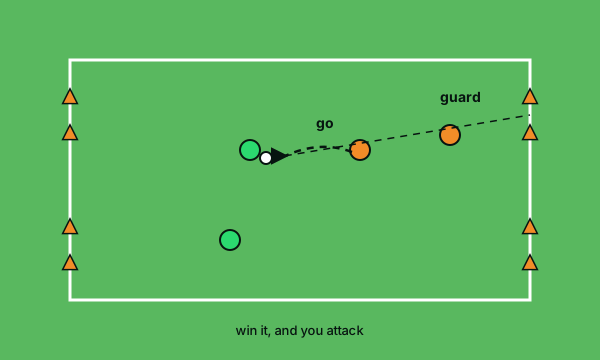 Go and Guard 2v2: one goes to the ball, one guards the gate.
Small-sided games: from 2v2 to 4v3
Target Player 2v2
Goal: passing forward and moving to receive (“Encourage teamwork and co-operation”). Setup: 15×20 yards and teams of 3: two inside and one “target” in a 3-yard strip behind the other team’s end line. Leave clear space behind each strip, away from other fields, fences and spectators. Duration: 8 minutes, in 2-minute rounds. How to play: 2v2. Score with a ground pass to your target, who controls it; the passer then swaps with the target. If the other team wins the ball, they attack their own target. Easier: the target can move along the whole line; a wider field. Harder: the target plays it straight back, and the goal counts only if the passer gets it; or 3v3 with targets. Safety: ground passes, and targets never come in to defend.
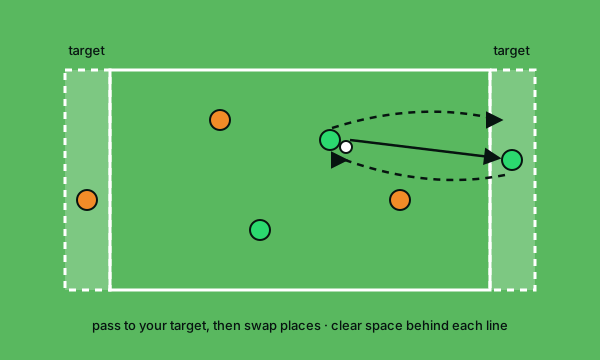 Target Player 2v2: pass to your target to score, then swap places.
4v3 With a Joker
Goal: attacking with an extra player and finding the free teammate. The guide’s list of small-sided games includes 4v3. Setup: 20×25 yards with two small goals (cones 3 yards apart or secured pop-ups), and 3v3 plus a “joker” in a third pinnie color who always plays for the team with the ball. Keep spare balls handy. Duration: 8-10 minutes; change the joker every 2 minutes. How to play: no goalkeepers. Whichever team has the ball attacks with 4. Easier: more space, or fewer players: 3v2 or 4v2. Harder: the joker plays two-touch, or can’t score. Safety: controlled contact, and nobody climbs on the goals.
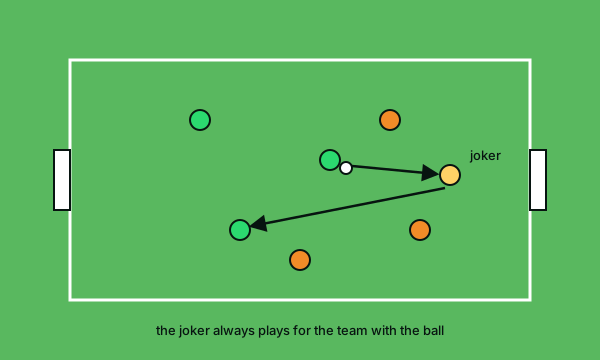 4v3 With a Joker: the joker always plays for the team with the ball.
Tactics: the 4v4 game, with every kid in every role
4v4 Diamond Rotation
Goal: playing 4v4 with a game model and trying every role: “How to play 4v4 using a game model,” “Attacking and defending roles in 4v4,” “4v4 formations: 1-2-1 (no GK)” and “Players to experience all positions.” Setup: your league’s U8 field (usually about 25-35 yards long and 15-25 wide; see U8 soccer rules), small goals, no goalkeepers, and pinnies numbered 1 to 4. Duration: 16-20 minutes: four 4-minute parts with a minute for water in between. How to play: 4v4. In each part, every kid takes a different spot in the diamond (back, left, right, front), so after four parts everyone has tried all four. The diamond is a starting point, not a place to stand still: kids move with the play. Easier: 3v3 in a triangle. Harder: a team that wins the ball has 10 seconds to score a double goal. Safety: controlled contact, with goals secured and checked.
If the game keeps collapsing into one big swarm, that’s normal at this age; how to stop bunch ball has games for it.
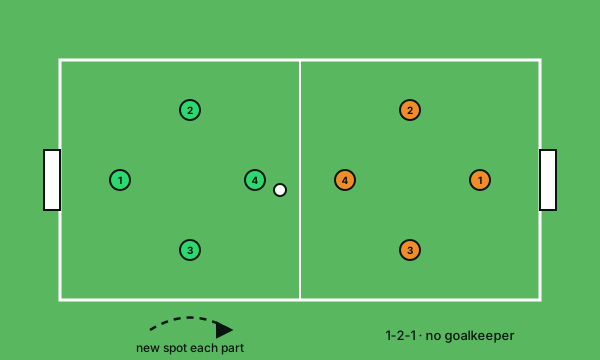 4v4 Diamond Rotation: a new spot in the diamond every part, and the diamond moves with the ball.
How do you turn these into a practice?
Pick three or four: one where every kid has a ball, one or two for the skill of the day, and finish with a game. That’s the Play-Practice-Play structure U.S. Soccer teaches in its grassroots courses: play, practice one thing, play again. Its 2018 explainer contrasts it with “traditional practices that may have children standing in lines, running laps and participating in drills that don’t resemble the game of soccer.” To put these into a 60-minute plan, minute by minute, see the U8 soccer practice plan.
What does this age look like in Spain?
What I see in grassroots soccer in Spain is that at 7 and 8, kids in the clubs I follow still play a futsal-style format: four players plus a goalkeeper. That’s a contrast, not advice: US rec at U7-U8 is usually 4v4 with no goalkeeper, so play what your league plays. They train twice a week for an hour, plus the weekend game, and sessions open with ball work: some dribbling, some passing, a few shots.
Two kinds of exercise come up again and again. One is games that clearly split 2 attackers from 2 defenders and work the switch from defending to attacking; Go and Guard 2v2 and Target Player 2v2 above already build that switch in, since whoever wins the ball attacks right away. The other is 1v1 dribbling duels, to build skill and start learning to shield the ball with the body, never by pushing or charging. The 1v1 Gates game works well for those duels.
FAQ
How many players should U8 drills use?
Anything from 1v1 to 4v4: that’s the range in U.S. Soccer’s U7-U8 guide, which also lists uneven games like 2v1, 3v2 and 4v3. Its format chart says “Training games at all age groups should include unbalanced teams (2v1, 3v2 etc).”
Should U8 players practice as goalkeeper?
In the clubs I follow in Spain, kids this age usually rotate in goal, but it’s also when some start to stick with it, and some clubs add goalkeeper training on a separate day. Treat that as a contrast. Most US recreational U8 is 4v4 with no goalkeepers (AYSO’s rules for U7 and U8: “4-a-side (No goalkeepers)”), and U.S. Soccer’s U7-U8 guide asks coaches to “Provide opportunities for all players to play as goalkeeper (if a GK is used).” If your league uses keepers, rotate everyone. For a goalkeeping game with no diving, see Goalie Wars.
Can 7- and 8-year-olds head the ball?
No, not in games or in practice. Every rulebook we checked bans heading at these ages; U8 soccer rules shows what each organization says.
How long should each drill last?
Most games here run 5-10 minutes, in short rounds with breaks. Shorter rounds usually beat one long block at this age, and on hot days the whole practice should be shorter.
Sources
- U.S. Soccer, Guide to Coaching U7s and U8s (The U.S. Way, 2026): documents.ussoccer.com
- U.S. Soccer, Age-appropriate soccer formats for training and games (The U.S. Way, 2026): documents.ussoccer.com
- U.S. Soccer, “Five Things to Know About Play-Practice-Play” (2018): ussoccer.com
- US Youth Soccer, AYSO and US Club Soccer, “Updated Decision on Age Group Formation” (June 10, 2025): usyouthsoccer.org
- AYSO, Age Group Chart, Starting Fall 2026 Season: ayso.org
- AYSO, Referee Guideline 2026-2027: wiki.ayso.org
- US Youth Soccer, Policy on Players and Playing Rules (as of June 23, 2026): usyouthsoccer.org
- Cal South, 2026-27 PDI Matrix: calsouth.com
- North Texas Soccer, Bylaws and Rules 2026/27: ntxsoccer.org
- Florida Youth Soccer (FYSA), Rules (last modified August 2026): fysa.com
- Massachusetts Youth Soccer, Survival Guide: 4v4 (U8): mayouthsoccer.org
- U.S. Soccer, Heat Guidelines (Recognize to Recover): folsomlakesurf.org
- U.S. Consumer Product Safety Commission, Guidelines for Movable Soccer Goals: cpsc.gov

Peter D. — Peter D. is KickZone’s editor. Based in Spain and closely involved in grassroots youth soccer there, Peter turns the way Spanish kids learn the game into practical help for US parents and volunteer coaches. Rules always come straight from the official rulebooks, cited.