
Soccer Drills for 6-Year-Olds: 10 Games (With Diagrams)
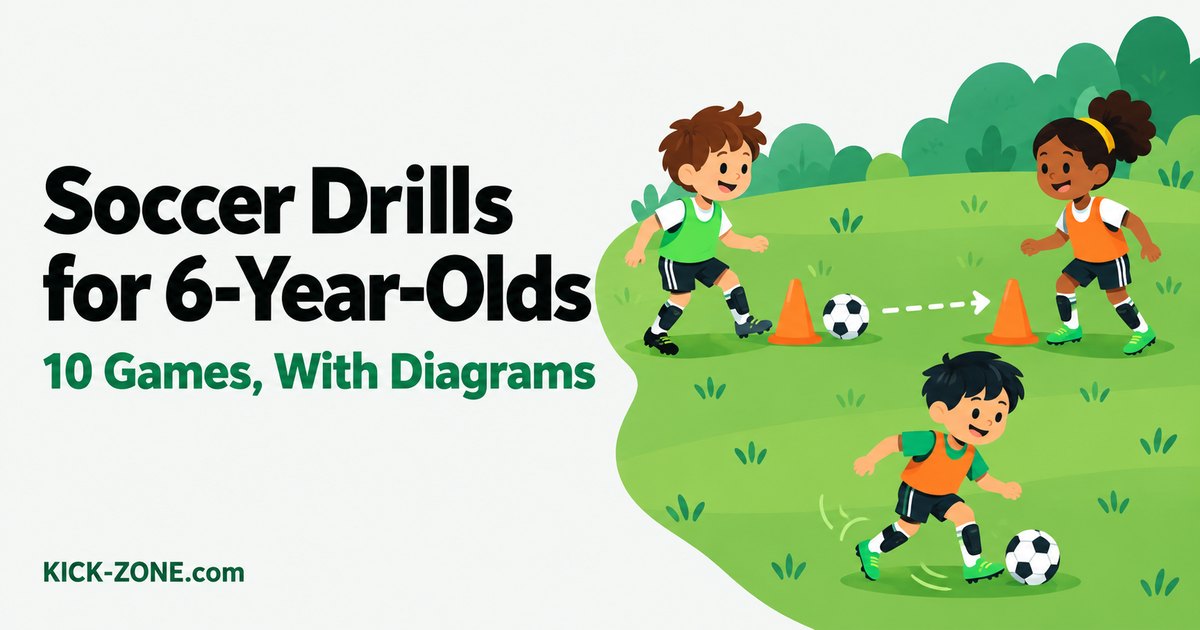
Soccer drills for 6-year-olds should start with a ball for every kid, then move on to pairs and small games. This is the age to start introducing what U.S. Soccer’s U7-U8 guide lists: skills with both feet, short passing and receiving, winning the ball back, and uneven games like 2v1. Below are 10 games grouped by skill, each with setup, time, an easier and a harder version, and a safety note.
New to coaching? Start with the first-time coach guide. This page is the next step after the drills for 5-year-olds.
Is a 6-year-old U6 or U7?
It depends on the birthday and on your league. For 2026-27, US Youth Soccer, AYSO and US Club Soccer group players by school year, August 1 to July 31. A child who turned 6 before August 1, 2026 would be U7 by single-year age grouping; one who turned 6 on or after that date would be U6. The age group calculator does the math.
Your league may not have a U7 division at all. AYSO puts U7 and U8 together in 8U (born August 1, 2018 through July 31, 2020), and at these ages US Youth Soccer’s national policy only defines 6U and 8U, though state associations can vary it. Cal South lists 7U on its own, and North Texas still uses December 31, so check its registration page instead of doing the math.
So a team of 6-year-olds can include kids who just turned 6 and, in two-year divisions, kids who are already 8. AYSO’s Kickstart manual puts it plainly: “a child’s chronological age can often conflict with developmental age, so flexibility is usually required.” That’s why every game below has an easier and a harder version.
What changes in soccer drills at age 6?
A 6-year-old sits right on the line U.S. Soccer’s 2026 guidance draws between U5-U6 and U7-U8:
| U5-U6 | U7-U8 | |
|---|---|---|
| Training games | 1v1, 2v1 and 2v2: “No structure or tactics. Focus on enjoyment” | “1v1, 2v1, 2v2, 3v2, 3v3, 4v3, 4v4” |
| Ball skills | Not broken down in the format chart | “Fundamental soccer skills with both feet,” “Introduce short passing and receiving,” “Introduce defending skills and winning the ball back” |
| Playing together | Not broken down | “Encourage teamwork and co-operation,” “Players to experience all positions” |
| Heading | Not allowed | “No heading in practice or games” |
These are guides for training, not rules for official games. One line in the format chart covers every age: “Training games at all age groups should include unbalanced teams (2v1, 3v2 etc).”
If your team plays U6, stay in the left column. For U5-U6, U.S. Soccer recommends small-sided games of 1v1, 2v1 and 2v2, with “No structure or tactics. Focus on enjoyment.” The 3v1, 3v3 and 4v4 games below are U7-U8 steps: with a U6 group, play them as 2v1 or 2v2 on more, smaller fields.
Massachusetts Youth Soccer, a US Youth Soccer state association, says in its Survival Guide: 4v4 (U8) that U8 practices “might start to look a little more like the traditional game of soccer (compared to U6 practices),” but kids still need a story: “instead of defenders in an activity, they could be bandits.” It’s written for 7- and 8-year-olds, so for 6-year-olds treat it as a direction, not a target.
What safety rules apply to every game?
- No heading, in any form. U.S. Soccer’s U7-U8 guide says “No heading in practice or games,” and AYSO, North Texas and Florida rule it out at these ages too. None of these games use the head, with any kind of ball.
- Nobody in the path of a shot, including behind or beside the goal.
- Foot to ball only: no pushing, holding or sliding tackles. Stop the game if anyone falls.
- Goals: cones are simplest. Pop-up goals get installed and secured the way the manufacturer says and your facility allows, checked before use, and nobody climbs or hangs on them. The CPSC’s guidelines are written for full-size goals, but the same habits apply. Before you buy a goal, new or used, search cpsc.gov for recalls and warnings.
- Heat: water with no limit. On hot days, U.S. Soccer’s heat guidance calls for more water breaks, a shorter practice or a cooler time. Exertional heat stroke is a medical emergency: call 911.
- Thunder: stop and get everyone to shelter right away, before picking up any gear. AYSO’s guidance is to wait 30 minutes after the last thunder, or for the official all-clear; follow your league’s or facility’s policy.
- A knock to the head: stop play. If a head injury is suspected, the child sits out the rest of the day, even if they say they feel fine. That’s our own rule, on the cautious side. Tell the family and your league, follow the league’s concussion protocol, and get a health professional’s OK before they play again.
Ball mastery games with both feet
What I see in grassroots soccer in Spain is that practices at this age are still game-style and always with a ball: one per kid most of the time, one per group in team games.
Turn and Go
Goal: changing direction with both feet, using the inside, outside and sole. Setup: a 20×20-yard square with 4 cones, one size-3 ball per kid. Duration: 6 minutes, in rounds of 60-90 seconds. How to play: everyone dribbles freely. On “Turn!”, each kid turns and heads a new way. Then name the surface (“Inside!”, “Outside!”, “Sole!” to pull it back) and a foot for each round. Easier: just “Turn!”, any way, in a bigger square. Harder: foot and surface together (“Left foot, outside!”) in a 15×15 square. Safety: “look before you turn”; enlarge the square if kids bump.
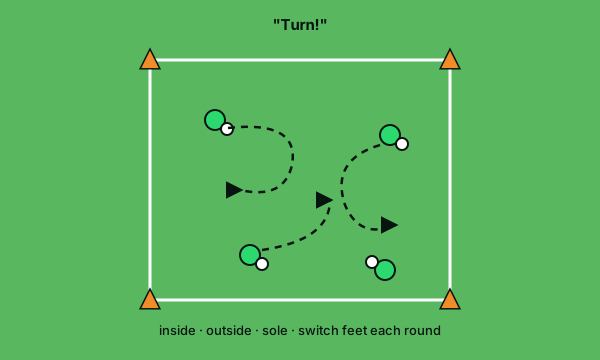 Turn and Go: dribble anywhere, turn on the call, switch feet each round.
Gate Hunt
Goal: dribbling with the head up and choosing where to go. U.S. Soccer’s guide asks coaches to “encourage player choice.” Setup: a 20×25-yard area with 6-8 gates (two cones 1.5-2 yards apart) scattered around, one ball per kid. Duration: 6-8 minutes, in 60-second rounds. How to play: in 60 seconds, dribble through as many different gates as you can, counting out loud; the same gate twice in a row doesn’t count. Next round, beat your own number. Easier: more gates, 3 yards wide. Harder: 1-yard gates, weaker foot only, or 1-2 “gatekeepers” without a ball. A gatekeeper waits a couple of yards beside a gate and, on your signal, closes it by stepping in before anyone arrives. Safety: one kid per gate; if it’s busy, find another. Gatekeepers stay out of the dribbling path, move only on your signal and never step in front of a kid already going through. No contact.
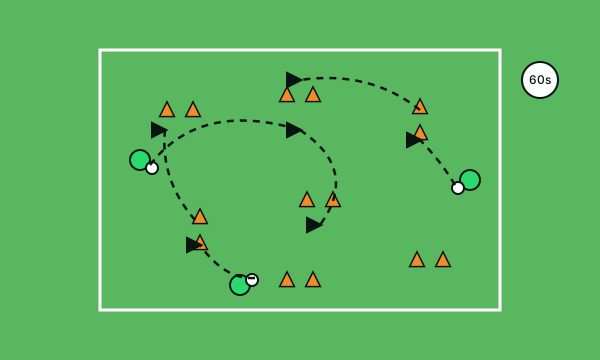 Gate Hunt: as many different gates as you can in 60 seconds.
First passing and receiving games
U.S. Soccer’s U7-U8 guide adds “Introduce short passing and receiving.” In the grassroots clubs I follow in Spain there’s a lot of passing and possession play at this age, and a lot of control-and-pass work; the exact games depend on each team’s idea of play, so there’s no single “Spanish drill.” These three are my own take in that spirit.
Gate Passing on the Move
Goal: passing to a target, then moving to the next. It builds on Pass the Gate. Setup: the Gate Hunt area, with pairs sharing one ball. Duration: 8 minutes, in 90-second rounds. How to play: each pair finds an open gate; one passes through it to the other on the far side, then both move to a different gate. Count gate-passes per round. Easier: 3-yard gates, partners standing still 3-4 yards apart. Harder: one touch to control, one to pass; every other pass with the weaker foot; 6-7 yards apart. Safety: ground passes only, and never a gate another pair is using.
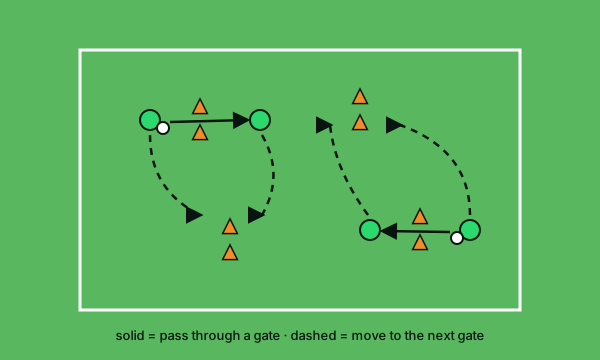 Gate Passing on the Move: pass through a gate, then find the next one together.
First Touch Through the Gate
Goal: a first touch that moves the ball to the side instead of stopping it dead. It builds on Control and Pass. Setup: pairs 5-6 yards apart, one ball each, with a 1-yard gate 1-2 yards to one side of the receiver. At least 5 yards between pairs. Duration: 6-8 minutes; swap roles every 60 seconds and move the gate to the other side. How to play: one partner passes along the ground; the receiver’s first touch pushes the ball through the side gate, then they pass back. Easier: a 2-yard gate, 4 yards apart; any touch counts if the ball ends past the gate. Harder: the gate on the weaker-foot side, the pass back with the other foot, 7 yards apart. Safety: pairs side by side with space between them; ground passes only.
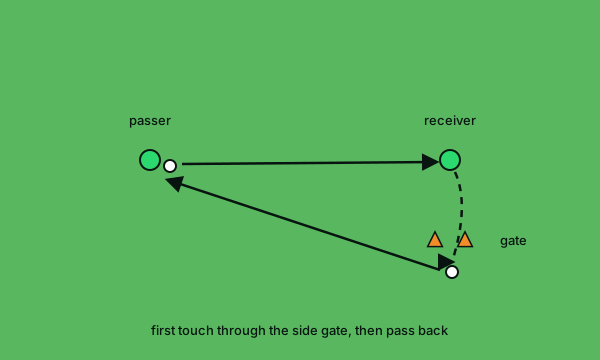 First Touch Through the Gate: first touch through the side gate, then pass back.
3v1 Keep-Away Square (a simplified rondo)
In the grassroots clubs I follow in Spain, 6- and 7-year-olds already play rondos, usually 3 or 4 players around 1 in the middle. A rondo is a keep-away circle: a few players pass while the one in the middle tries to win the ball. This square is a simplified version that builds on Keep-Away with Lots of Space.
Goal: keeping the ball as a group by moving to an open passing line (“Encourage teamwork and co-operation”). Setup: 10×10-yard squares (start at 12×12), 3 passers and 1 defender per square, one ball, at least 5 yards between squares. Duration: 6-8 minutes, with a new defender every 60 seconds. How to play: the three pass inside the square and count passes in a row without the defender touching the ball. The middle player rotates on the clock, not on a steal, so nobody gets stuck there. Massachusetts Youth Soccer’s U8 guide notes that elimination games tend to knock out “the player who is struggling the most in the game.” Easier: a 12-15-yard square, a defender who walks at first, or 4v1. Harder: an 8-yard square, or 3v2 if you have a fifth player for that group. U6 group: play it 2v1 in a 10-yard square; U.S. Soccer’s list for U5-U6 stops at 2v2. Safety: the defender plays the ball, not the player. No sliding in.
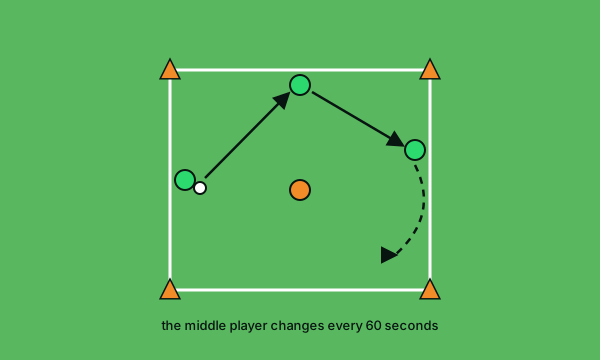 3v1 Keep-Away Square: keep it away from the middle, move to open up a pass.
1v1 and 2v1 games: dribble, pass or win it back
U.S. Soccer’s U7-U8 guide also lists “Introduce defending skills and winning the ball back.” These bring in a defender.
1v1 Gates
Goal: taking on a defender to score, and winning the ball back when you lose it. Setup: channels 10 yards wide and 15 long, a 2-yard gate at each end, one pair per channel, at least 5 yards between channels, spare balls outside. Duration: 6-8 minutes, in rounds of 30-45 seconds; swap roles every round. How to play: the defender passes from one end to the attacker at the other, then steps up to defend. The attacker scores by dribbling through the far gate and stopping the ball on the line. If the defender wins it, they score through the other gate. Easier: a 3-yard gate and a wider channel; the defender starts farther back. Harder: a 1-yard gate, or two small gates at each end. Safety: foot to ball only; no pushing, holding or sliding in. If anyone falls, stop the round. Defenders come from the front, never from behind.
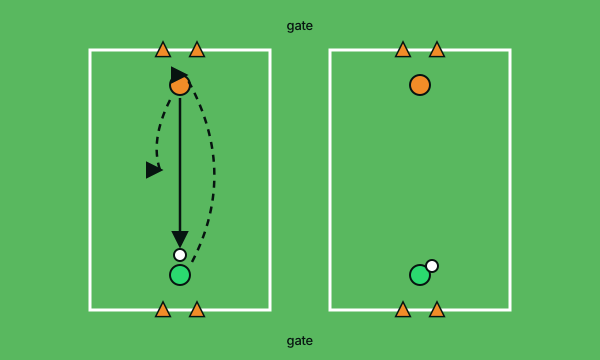 1v1 Gates: serve, defend, and score through the far gate if you win it.
Two-on-One Breakaway
Goal: the first passing decision: pass when the defender comes to you, keep dribbling when they don’t. Setup: 15 yards wide by 20 long, with a 3-yard end zone at one end. Two attackers sharing one ball start at the other end; one defender starts in the middle. Duration: 8 minutes, in rounds of about 30 seconds; rotate so everyone defends. How to play: the attackers score by dribbling into the end zone and stopping the ball with the sole. If the defender wins it, they score by dribbling back over the start line. Easier: the defender only blocks, no stealing, for the first rounds; a wider area. Harder: a 3-yard gate instead of the end zone, or 3v2 with a U7 group. Safety: the same contact rules as 1v1 Gates, one game per area.
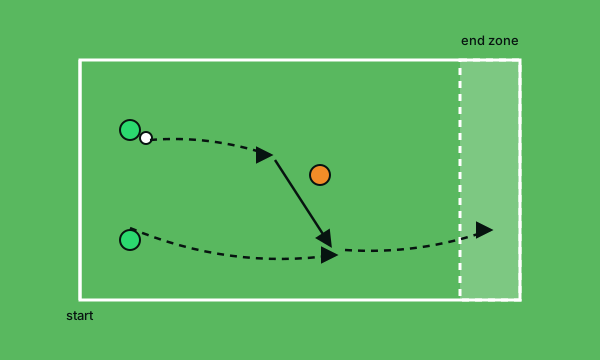 Two-on-One Breakaway: two attackers, one ball, one defender.
Goalie Wars (optional)
Goal: catching, rolling and throwing. U.S. Soccer’s U7-U8 guide lists goalkeeping basics, including throwing and catching, and asks coaches to “provide opportunities for all players to play as goalkeeper (if a GK is used).” It also mentions diving; this game leaves diving out. It builds on Goalkeeper for a Minute. Setup: two 4-yard cone goals facing each other 8-10 yards apart, one ball per pair, each pair in its own lane at least 5 yards from the next. Duration: 5-6 minutes, in 60-second rounds. How to play: each kid guards a cone goal and scores by rolling the ball, or throwing it low and underarm, past their partner. Whoever stops it attacks from their own line. Easier: rolling only, 3-yard goals, closer together. Harder: low underarm throws, wider goals. Safety: rolls and low throws only, never at anyone’s face. No diving. Cone goals on grass, with nothing to tip over.
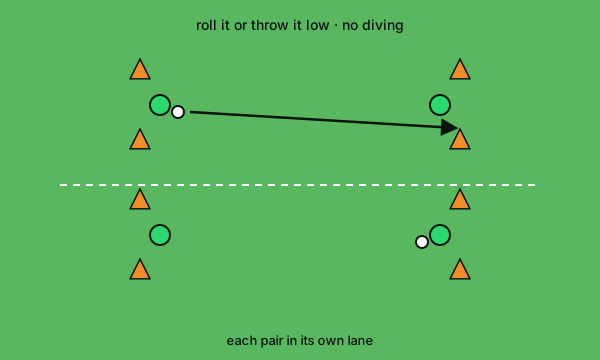 Goalie Wars: roll it past your partner, then save theirs. No diving.
Small-sided games with lots of goals
U.S. Soccer’s U7-U8 guide sums up practice design as “Introduce basic routines and practice structure | Provide lots of opportunities to score goals.”
Both games are written as 3v3, a U7-U8 format. If your team plays U6, run them as 2v2 on two smaller fields, in line with U.S. Soccer’s 1v1 to 2v2 for U5-U6.
End Zone 3v3
Goal: a real game with lots of goals and no goalkeepers. Setup: a 20×15-yard field (25×20 for 4v4) with a 3-yard end zone at each end, pinnies, spare balls on the sideline. Duration: 8-10 minutes, in two halves with water in between. How to play: 3v3. Score by dribbling into the other team’s end zone and stopping the ball with the sole. After a goal, roll a new ball to the other team. Easier: a wider field; just crossing the line counts. Harder: one pass before scoring, or a goal counts only if a teammate receives a pass in the zone. Safety: no diving or sliding into the zone; if kids pile up, stop and restart.
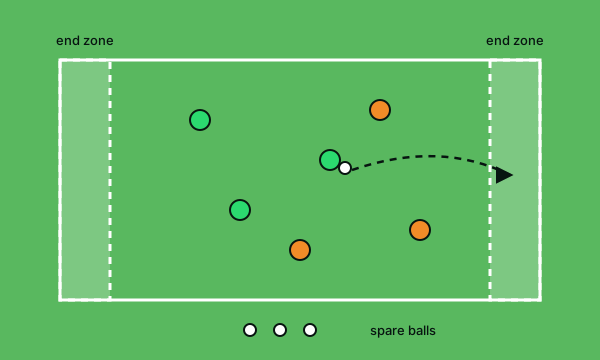 End Zone 3v3: dribble in and stop the ball to score.
Four-Goal 3v3
Goal: looking up and switching to the open goal. AYSO’s Kickstart manual: “Four goal games (one on each corner approximately 12 yards apart) can increase scoring FUN and help with directional awareness. Each team attacks two goals and defends two goals.” Setup: a 20×15-yard area with a small goal at each corner, two per end line, and pinnies. That’s smaller than the roughly 30×18 yards Kickstart uses for 3v3, so enlarge it if your group needs room. Cone goals 2 yards wide are simplest. Duration: 8-10 minutes, in two halves. How to play: 3v3, no goalkeepers. Each team attacks the two goals on one end line and defends the other two. If one goal is crowded, switch to the other. Easier: wider goals, plus Kickstart’s “new ball” restart: roll in a spare ball whenever one goes out. Massachusetts Youth Soccer gives U8 coaches the same tip: keep a supply of balls close by. Harder: a goal counts double after switching sides with a pass, or 4v4 with a U7 group. Safety: pop-up goals installed and secured per the manufacturer, checked before play, with the area around them clear. Nobody climbs or hangs on them.
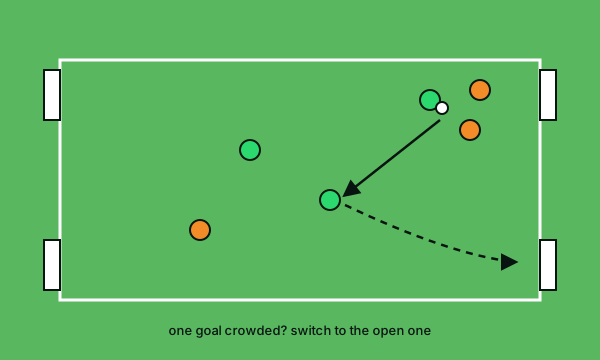 Four-Goal 3v3: two goals to attack, so look for the open one.
How do you fit these into one practice?
Don’t run all ten in one session. Pick one game where everyone has a ball, one or two for the skill of the day, and finish with a small-sided game. For a U6 team, the U6 practice plan lays out a full session, and the younger kids on a mixed team may still be happier with the 5-year-old games; older or more advanced kids can step up to the U8 soccer drills, and a U7 team can follow the U8 practice plan. If the final game turns into one big swarm, see how to stop bunch ball.
What changes from 5 to 6 in Spain?
What I see in grassroots soccer in Spain is that from about age 6, practices add longer possession games with a lot of passing, and matches get more intense. Sessions usually open with ball work that doubles as the warm-up: a bit of dribbling, some passes, a few shots. The rondo-style square above is the easiest piece of that to borrow for a US rec team.
FAQ
What soccer skills should a 6-year-old have?
There’s no official checklist, and kids this age vary a lot. U.S. Soccer’s U7-U8 guide lists what to introduce next: both feet, short passing and receiving, defending and winning the ball back, and shooting (its own example is “Shooting from 5-10 yards”), plus movement skills like running, skipping, hopping, jumping and landing, and throwing and catching. Treat it as a direction, not a test.
How long should soccer practice be for 6-year-olds?
No national rule sets it. AYSO’s Kickstart program for 5- and 6-year-olds caps its sessions at “1 hour maximum, includes organizing time and breaks,” a guideline for that program. Massachusetts Youth Soccer’s U8 guide gives “1 day a week with 30 minutes of training followed by 30 minutes of game play” as an example. On hot days, go shorter.
Should 6-year-olds play positions?
Not fixed ones. U.S. Soccer’s guidance has no structure or tactics at U5-U6; at U7-U8 it introduces attacking and defending roles in 4v4, with a 1-2-1 shape as a reference, and “Players to experience all positions.” Rotate kids through every job. More in how to stop bunch ball.
Is heading allowed for 6-year-olds?
No, not in games or in practice. Every rulebook we checked bans heading at this age; see U6 soccer rules and U8 soccer rules for each organization.
Sources
- U.S. Soccer, Age-appropriate soccer formats for training and games (The U.S. Way, 2026): documents.ussoccer.com
- U.S. Soccer, Guide to Coaching U7s and U8s (The U.S. Way, 2026): documents.ussoccer.com
- US Youth Soccer, AYSO and US Club Soccer, “Updated Decision on Age Group Formation” (June 10, 2025): usyouthsoccer.org
- AYSO, Age Group Chart, Starting Fall 2026 Season: ayso.org
- US Youth Soccer, Policy on Players and Playing Rules (as of June 23, 2026): usyouthsoccer.org
- Cal South, 2026-27 PDI Matrix: calsouth.com
- North Texas Soccer, Bylaws and Rules 2026/27: ntxsoccer.org
- Florida Youth Soccer (FYSA), Rules (last modified August 2026): fysa.com
- AYSO, 6U Kickstart Program Manual: wiki.ayso.org
- AYSO, Referee Guideline 2026-2027: wiki.ayso.org
- Massachusetts Youth Soccer, Survival Guide: 4v4 (U8): mayouthsoccer.org
- U.S. Soccer, Heat Guidelines (Recognize to Recover): folsomlakesurf.org
- U.S. Consumer Product Safety Commission, Guidelines for Movable Soccer Goals: cpsc.gov

Peter D. — Peter D. is KickZone’s editor. Based in Spain and closely involved in grassroots youth soccer there, Peter turns the way Spanish kids learn the game into practical help for US parents and volunteer coaches. Rules always come straight from the official rulebooks, cited.