
U6 Soccer Practice Plan: Free 45-60 Minute Plan (Printable)
A good U6 practice runs 45-60 minutes, picks one technical theme rather than three, and keeps a ball at every player’s feet as much as possible — no lines, no laps, no long talks. A simple split: 10-12 minutes of warm-up ball work, 15-20 minutes of games built around that one skill, a water break, a small-sided scrimmage, and a few minutes of setup and transitions worked in between. This plan gives you that structure with diagrams for each block, a free printable, and what still depends on your league.
If you’re brand new to coaching this age group, start with the first-time coach guide — it covers gear, safety basics and league rules to confirm. This page is just the plan itself. Coaching 7- and 8-year-olds? Use the U8 practice plan.
How long should U6 practice be, and how is the time split?
No rulebook dictates exactly how a U6 practice has to be timed — that’s a coaching decision, not a league rule. The closest anchor point comes from AYSO’s 6U Kickstart manual, which caps a full session at one hour maximum, including organizing time and breaks. This plan fits comfortably inside that, split into five blocks:
| Block | Minutes | What the coach does |
|---|---|---|
| Warm-up (ball at every foot) | 10-12 | Two short dribbling games; keep any explanation under 2 minutes |
| Skill of the day | 15-20 | One technical theme, worked through 2 games from different angles |
| Water break | 2-3 | A real pause — don’t turn it into more instruction |
| Scrimmage | 15-20 | A small game; the real match format is whatever your league plays (more below) |
| Setup and transitions | 3-5 | Getting balls out, moving between games, a quick huddle |
Why one theme instead of three? That’s an editorial call for this plan, not a literal U.S. Soccer mandate — but it fits comfortably inside the federation’s guidance. U.S. Soccer’s 2026 player-development framework is explicit that U5-U6 training should have “no structure or tactics” and focus on enjoyment, built around small-sided games like 1v1 and 2v2. That’s a statement about what to teach, not about whether a practice can have an organized flow — this plan still has a clear shape, it just never asks a 5- or 6-year-old to learn a formation or a tactic inside it. And on a genuinely hot day, treat the 45-60 minutes as a target, not a rule: U.S. Soccer’s heat guidance calls for more water breaks, a shorter session, or moving practice to a cooler time of day instead of pushing through the full plan.
What’s the warm-up (first 10-12 minutes)?
Two short games, both from the drill bank for 5-year-olds, cover this block well:
- Red Light, Green Light (5-6 minutes) — free dribbling inside a coned square, freezing the ball dead on command.
- Cone Slalom (6-8 minutes, or trim to 4-5 if you’re short on time) — set up one zigzag line for every 2 kids so nobody waits more than a few seconds; each kid dribbles the zigzag and jogs back with the ball for the next kid in their line.
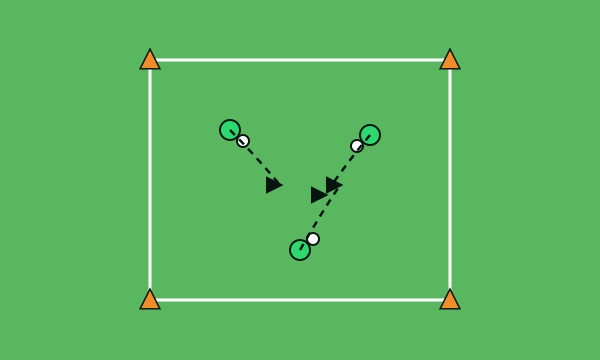 Warm-up: everyone inside the coned area, each with their own ball underfoot.
Both keep a ball at every kid’s foot the whole time, which is the actual point of a warm-up at this age — not raising a heart rate, but racking up touches before the real work starts.
What’s the “skill of the day” block (15-20 minutes)?
Pick one theme per practice and build it from two angles, rather than trying to cover several skills in one session. For week 1, ball control is a natural starting point:
- Freeze Dribble (5 minutes) — free dribbling in a shared space, stopping the ball dead on the whistle.
- Catch My Pass (6-8 minutes) — partners roll the ball to each other, working on a clean first touch.
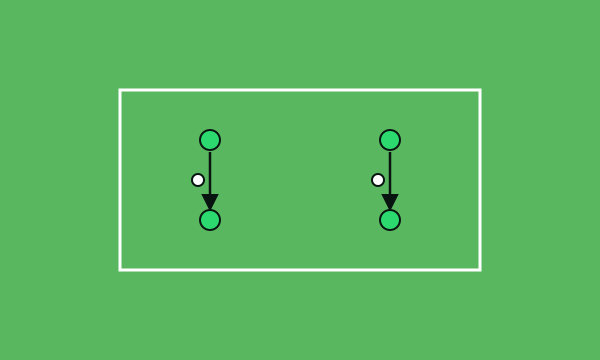 Skill of the day: pairs working the same theme from a different angle.
For the weeks after that, the printable below has a blank “skill of the day” line and two game slots. Pick whatever theme your team needs next and choose 2 games from the full drill bank that work it from different angles — the bank is grouped by exactly that: dribbling, stopping and receiving, shooting, 1v1, and passing, so skimming one section gets you both games for the week already paired.
How do you end practice?
Close with a small scrimmage — but go in knowing that the actual game format and length your team plays on game day depends on your league, not on this plan:
| League | What they actually play at this age |
|---|---|
| US Youth Soccer | No more than 4 per side, 3 strongly recommended |
| AYSO (recreational) | 4-a-side, no goalkeeper |
| AYSO 6U Kickstart | 3v3 or 4v4, to four small goals instead of two |
| North Texas | 4v4 or 3v3 |
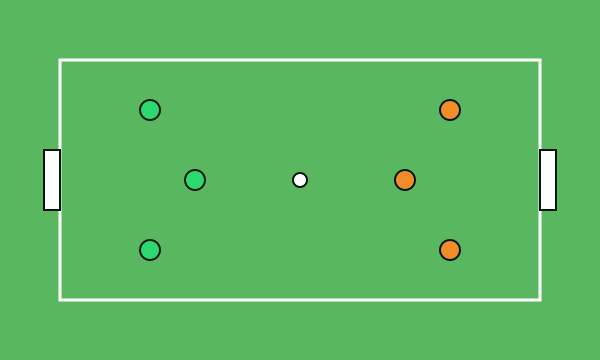 A small scrimmage to close practice — scale it to however many kids showed up, whatever your league plays on game day.
For the full picture of what’s fixed nationally versus what your league sets on its own, see U6 soccer rules. For practice purposes, just scale the scrimmage to however many kids showed up — 3v3 with a sub is a perfectly good scrimmage even if your league plays 4v4 on Saturday. You don’t need a full-length match to make it worthwhile, either: U.S. Soccer’s 2017 player-development standards note that formal games aren’t necessary at all, and that playing with and against teammates at the end of each practice, once or twice a week, is enough.
If you’re bringing portable goals for the scrimmage, secure them the way the manufacturer says — stakes on grass, weights on hard surfaces — before anyone touches them, and never let kids climb or hang on them. Check them before use. The CPSC’s guidelines on movable soccer goals are written for full-size goals, not small pop-up goals, but the same habits apply to any goal. Before you buy a goal, new or used, search cpsc.gov for recalls and warnings.
And if the scrimmage turns into every kid chasing the ball in one clump, that’s completely normal at this age — how to stop bunch ball has games that ease it without lectures about spreading out.
How does this compare to a practice session in other countries?
What I see in grassroots soccer in Spain is sessions built almost entirely around game-based drills with a ball each — early in the season, that’s nearly the whole practice. The free scrimmage grows into a bigger piece of the session as the season goes on, used to work on things that came up in those games. This plan leans the same direction: a short scrimmage from week one (the US guides it’s built on include one too, and kids this age love it), with room to let it take up more time later in your season if that’s what your team needs.
Free printable: your U6 practice plan, one page
Print this once and reuse it every week — just fill in the blanks by hand. Want a blank version with room to sketch your own setups? Use the soccer practice plan template.
| Block | Minutes | Skill of the day / game | Equipment | Goal |
|---|---|---|---|---|
| Warm-up | ___ | Red Light, Green Light + Cone Slalom (or your pick) | 1 ball per kid, 4+ cones | Touches on the ball |
| Skill of the day | ___ | Skill: _______ · Game 1: _______ · Game 2: _______ | Depends on the games chosen | One theme, two angles |
| Water break | ___ | — | Water for every kid | A real pause |
| Scrimmage | ___ | Small-sided game | Pinnies or 2 colors, small goals | Game-like play |
Three things don’t change, whatever you fill in above:
- No heading — any ball, any drill.
- Shin guards on, fully covered by socks.
- Water available the whole time — don’t ration it, and shorten or skip practice if it’s dangerously hot.
Confirm with your league once and write it on the printable: game format, duration, and who referees.
Download the free printable U6 practice plan (PDF)
FAQ
Do I need a new plan every single week?
No — reuse this structure every week and just swap the skill of the day and the two games that go with it. Kids this age actually like the predictability of warm-up, skill, water, scrimmage; what keeps it fresh is changing the 15-20 minutes in the middle, not reinventing the whole session.
What if the kids finish an activity early?
That’s normal — attention spans vary a lot week to week. Have a default “filler” ready (another round of the warm-up game works fine) rather than improvising something new on the spot, and don’t be afraid to move to the water break or scrimmage early if a game has clearly run its course.
How many coaches do you need for 10-12 U6 players?
One coach can run this plan, but two makes it noticeably easier — one leading the activity, one helping kids who wander off or need a hand tying a shoe. If you’re coaching alone, the parent email from the first-time coach guide is the fastest way to line up a regular second set of hands.
Sources
- U.S. Soccer, Age-appropriate soccer formats for training and games (The U.S. Way, 2026): documents.ussoccer.com
- US Youth Soccer, Policy on Players and Playing Rules (as of June 23, 2026): usyouthsoccer.org
- AYSO, Referee Guideline 2026-2027: wiki.ayso.org
- AYSO, 6U Kickstart Program Manual: wiki.ayso.org
- North Texas Soccer, Bylaws and Rules 2026/27: ntxsoccer.org
- U.S. Soccer Federation (hosted by US Youth Soccer), Player Development Initiatives (2017): usyouthsoccer.org
- U.S. Soccer, Heat Guidelines (Recognize to Recover): folsomlakesurf.org
- U.S. Consumer Product Safety Commission, Guidelines for Movable Soccer Goals: cpsc.gov

Peter D. — Peter D. is KickZone’s editor. Based in Spain and closely involved in grassroots youth soccer there, Peter turns the way Spanish kids learn the game into practical help for US parents and volunteer coaches. Rules always come straight from the official rulebooks, cited.