
Soccer Practice Plan Template: Free Printable PDF (Blank)
A soccer practice plan template is a page you fill in before each session: the date, age group, kids expected and one theme, then three blocks built Play-Practice-Play (arrival games, the skill of the day, a final game) with minutes, a quick sketch of each setup and the gear you need. This free US-letter template adds a season sheet and prints the safety rules that never change. Below: how to fill in every box.
Download the blank practice plan template (PDF, US letter). Free, no sign-up. Want to see one filled in? Use the U6 practice plan or the U8 practice plan.
New to coaching? Start with the first-time coach guide.
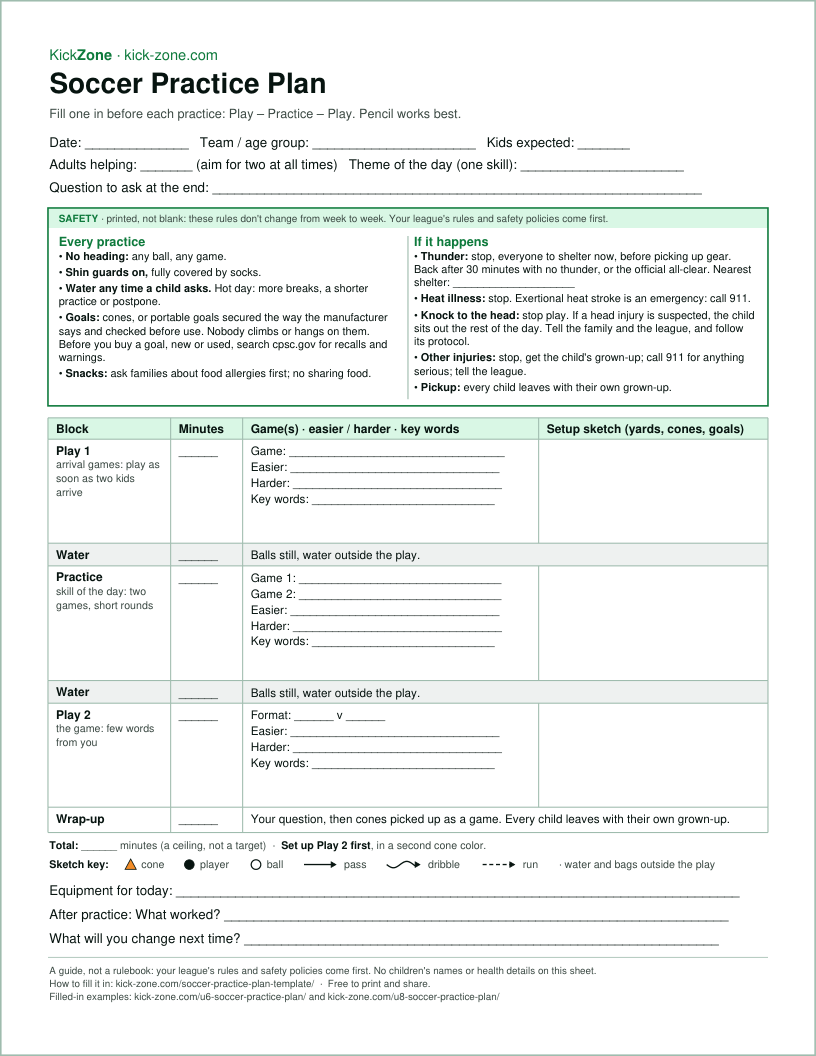 Page 1 is the weekly plan. Page 2 is the season sheet.
What safety rules are printed on every plan?
Both pages print the same safety box, above everything else, because these rules don’t change from week to week. A template can’t make a practice safe on its own, and your league’s rules and safety policies come first.
Every practice
- No heading, with any ball, in any game. U.S. Soccer’s coaching guides for U5 and for U7-U8 both say “No heading in practice or games,” and AYSO, North Texas and Florida rule it out at these ages.
- Shin guards on, fully covered by socks. AYSO says “Shinguards are required in all practices and games.” Check your league’s equipment rule.
- Water any time a child asks. Massachusetts Youth Soccer, a US Youth Soccer state association, says in its U8 guide: “anytime a child asks for water, always allow them time to drink.” On hot days, U.S. Soccer’s heat guidance calls for more water breaks, a shorter practice or postponing.
- Goals: cones are simplest. Portable goals get installed and secured the way the manufacturer says and your facility allows (on artificial turf, stakes may not be an option), checked before use, and nobody climbs or hangs on them. The CPSC’s guidelines are written for full-size goals, but the same habits apply. Before you buy a goal, new or used, search cpsc.gov for recalls and warnings.
- Snacks: ask families about food allergies first, and no sharing food.
If it happens
- Thunder: stop and get everyone to shelter right away, before picking up any gear. AYSO: “When thunder is heard, it is within striking distance. Seek shelter immediately.” Wait 30 minutes after the last thunder, or for the official all-clear, and follow your league’s or facility’s policy. The template has a blank for the nearest shelter: fill it in before kids arrive.
- Heat illness: stop the child’s play. Exertional heat stroke is a medical emergency: call 911.
- A knock to the head: stop play. If a head injury is suspected, the child sits out the rest of the day, even if they say they feel fine. That’s our own rule, on the cautious side. Tell the family and your league, follow the league’s concussion protocol, and get a health professional’s OK before they play again.
- Other injuries: stop play and get the child’s grown-up; for anything serious, call 911. Tell your league, too.
- Pickup: every child leaves with their own grown-up. AYSO’s Safe Haven rules say “No child shall be left unsupervised after a match or practice.”
What should a soccer practice plan include?
Each row is a box on the template:
| Box on the template | What to write | Why it’s there |
|---|---|---|
| Date · team / age group | “U6,” “U8 4v4” | Massachusetts Youth Soccer’s U8 session plans open with the age and format (“U8,” “4v4”) |
| Kids expected · adults helping | A number; “2 adults” | Massachusetts’ header: “PLAYERS 8-12.” AYSO’s Safe Haven policy: “1:8 or less” and “two adults present at all times” |
| Theme of the day | One skill | AYSO’s Kickstart: each week, one technique or piece of game knowledge, “introduced with game activities.” Massachusetts: kids take in “only 1-3 concepts at a time” |
| Three blocks, with minutes | Play 1 · Practice · Play 2 | U.S. Soccer’s Play-Practice-Play; each phase of Massachusetts’ plan lists its “DURATION” |
| Water rows | Break minutes | U.S. Soccer: “Use lots of short breaks” (U5), “Use regular short breaks” (U7-U8) |
| Setup sketch | Cones, kids, ball, arrows | Massachusetts draws a diagram for every phase |
| Easier / harder | One change each way | Massachusetts: “LESS CHALLENGING” and “MORE CHALLENGING” versions of its core activity. U.S. Soccer: “appropriate challenge (striking a balance between success and failure)” |
| Key words | 2-3 words | Massachusetts: “KEY WORDS” for each phase. U.S. Soccer’s U5 guide: “Keep instructions short and concise” |
| One question | For the end | Massachusetts: “What did you enjoy about the activity?” |
| Equipment for today | That day’s gear | AYSO’s Kickstart list for every session, extra balls included |
| After practice | What worked, what to change | Massachusetts’ self-reflection questions: “What did you do well?” and “What could you do better?” |
One rule of our own: no children’s names or health details on the sheet, because it lives in a folder at a public field. It’s the same spirit as AYSO’s social media policy, which says team rosters with names, numbers and contact information “must not be posted on any public website or social media page.”
How do you fill in the three blocks?
Some template sites still open practice with jogging laps and stretching. U.S. Soccer’s Play-Practice-Play explainer describes the opposite: an approach that “differs from traditional practices that may have children standing in lines, running laps and participating in drills that don’t resemble the game of soccer.” So the template has no box for laps or stretches.
- Play 1: arrival games. “In the first Play phase, players engage in small-sided games with the primary focus on having fun.” Start as soon as two kids arrive: with U7-U8, a 1v1 that grows to 3v3, as in the U8 practice plan; with U5, a game with a ball for every kid, like the body games in soccer drills for 4-year-olds.
- Practice: the skill of the day. U.S. Soccer calls this phase “targeted learning activities” of “appropriate challenge.” Write two games on the same theme, in short rounds: Massachusetts’ U8 guide finds kids stay more focused with “10-12 (1-minute rounds)” than with one 15-minute game, a rule of thumb. For 7- and 8-year-olds, the U8 soccer drills are grouped by theme.
- Play 2: the game. “The final stage of Play-Practice-Play is the game,” and “A coach should observe and guide using minimal dialogue if possible.” Write the format as ”___ v ___” to fit the kids who came; your league sets the game-day format.
- Wrap-up: your question, then cones picked up as a game.
Two habits from Massachusetts’ U8 guide are printed on the template too. Set up “backwards”: your last activity first, in a second cone color. And keep the balls still at water breaks; one of the rules the guide suggests agreeing on with kids is “Why do we have to be careful when kicking a soccer ball during a team water break? (so, no one gets hurt).”
How many minutes should each block get?
The template leaves the minutes blank, because they depend on the age group:
| Age group | Total | How it splits | Source and filled-in example |
|---|---|---|---|
| U5 | No official number | Short games, lots of short breaks | U.S. Soccer’s U5 guide: “Use lots of short breaks,” “Fun games focused on play” · soccer drills for 4-year-olds |
| U6 | “1 hour maximum, includes organizing time and breaks” | Warm-up 15 minutes, skills 15, “Big Match” 20, breaks included | AYSO’s Kickstart program for 5- and 6-year-olds · U6 practice plan (45-60 minutes) |
| U7-U8 | About 60 minutes | KickZone’s suggested split: 15 / 2 / 18 / 2 / 20 / 3 | Massachusetts Youth Soccer’s U8 session plans run “60 minutes” · U8 practice plan |
Kickstart’s blocks are one program’s guide for 5- and 6-year-olds, not a national template, and the manual adds: “Adjust play time and breaks as needed to suit your players, i.e., maturity level, weather, energy level.” Whatever you write, the total is a ceiling, not a target. On hot days, go shorter, add breaks or postpone.
Coaching 9- and 10-year-olds? The same three blocks work; minutes and game formats change, so check your league.
How do you sketch the setup?
Each main block has an empty box for a quick drawing. Under the boxes, the template prints a legend (our own convention, not an official one): a triangle for a cone, a dot for a player, a circle for a ball, a solid arrow for a pass, a wavy arrow for a dribble and a dashed arrow for a run.
What goes in the box: the size of the area in yards, where each group plays, the goals (cones are simplest), spare balls, and the water and bags, outside the play.
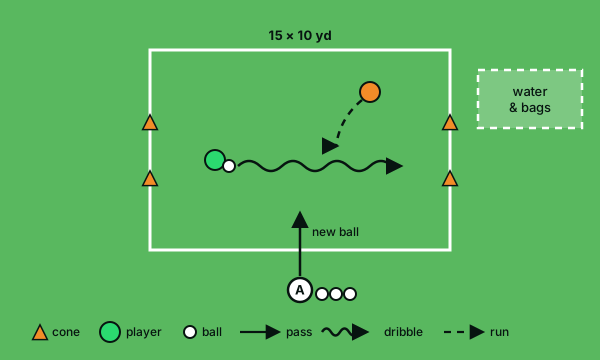 A filled-in setup box: a 1v1, a new ball rolled in from the side, and water outside the play.
How do you plan a whole season?
Page 2 of the template is a season sheet you fill in once:
- Confirm with your league: game format, game length, who referees, restarts (throw-in, pass-in, kick-in or dribble-in), whether there are goalkeepers, your practice day, time and field, and the league’s safety contact.
- Before every practice: arrive “at least 15 minutes early,” as Massachusetts’ U8 guide suggests; walk the field for holes and debris, and move your field away from anything you can’t fix; secure the goals; set up your last activity first; have spare balls ready; put water close by but outside the play; know where the nearest shelter is.
- Bring every time: AYSO’s Kickstart list includes a ball pump, an extra pair of shin guards, extra balls, a “Charged cell phone in case of emergency,” a basic first-aid kit you know your way around, and each child’s registration form with the Emergency Treatment Authorization. AYSO’s referee guideline puts it plainly: “It is the Coach’s responsibility to have the Player Registration Forms at all practices, and games.” If a child has prescribed medicine, know where it and the doctor’s plan are, and don’t assume you’re trained or authorized to give it.
- Season at a glance: an 8-week grid with week, date, theme, games and notes. One theme a week; repeat the ones your team needs. For comparison, AYSO’s Kickstart “consists of one day per week for 6-weeks,” in a set order, and its sessions “can be repeated” if the program runs longer.
Free printable: the blank template (US letter, 2 pages)
- Page 1, Soccer Practice Plan, one per practice: the plan’s details, the safety box, the six rows with a setup box for each main block, the sketch legend, today’s equipment and your notes after practice.
- Page 2, Season Sheet, once a season: the same safety box, your league’s answers, the two checklists and the 8-week grid.
Print it double-sided on one sheet if you like. Free to print and share, no sign-up.
Download the blank practice plan template (PDF, US letter)
FAQ
Is there an Excel or Word version?
Not right now. It’s a PDF made to print and fill in by hand.
What’s the difference between a practice plan and a session plan?
Only the name. Massachusetts Youth Soccer calls them session plans, and AYSO’s Kickstart manual lists a “Session plan” among the things to bring to every session.
How detailed should a practice plan be?
One page. Massachusetts’ U8 guide explains the final game in “30 seconds,” with what it calls PEP: “picture,” “explain,” “play.” My take: if it doesn’t fit in the box, it’s too much to say on the field.
Do I need a new plan every week?
No. Change the theme and the Practice games, and keep the structure; the U6 practice plan works the same way.
Sources
- U.S. Soccer, “Five Things to Know About Play-Practice-Play” (2018): ussoccer.com
- U.S. Soccer, Guide to coaching U5s (The U.S. Way, 2026): documents.ussoccer.com
- U.S. Soccer, Guide to Coaching U7s and U8s (The U.S. Way, 2026): documents.ussoccer.com
- Massachusetts Youth Soccer, U8 4v4 session plan, week 1: mayouthsoccer.org
- Massachusetts Youth Soccer, Survival Guide: 4v4 (U8): mayouthsoccer.org
- AYSO, 6U Kickstart Program Manual: wiki.ayso.org
- AYSO, Referee Guideline 2026-2027: wiki.ayso.org
- AYSO, Safe Haven Policies (AYSO wiki, accessed October 2026): wiki.ayso.org
- AYSO, Policy – Social Media: wiki.ayso.org
- North Texas Soccer, Bylaws and Rules 2026/27: ntxsoccer.org
- Florida Youth Soccer (FYSA), Rules (last modified August 2026): fysa.com
- U.S. Soccer, Heat Guidelines (Recognize to Recover): folsomlakesurf.org
- U.S. Consumer Product Safety Commission, Guidelines for Movable Soccer Goals: cpsc.gov

Peter D. — Peter D. is KickZone’s editor. Based in Spain and closely involved in grassroots youth soccer there, Peter turns the way Spanish kids learn the game into practical help for US parents and volunteer coaches. Rules always come straight from the official rulebooks, cited.