
Soccer Drills for 4-Year-Olds: 8 Games (With Diagrams)
Soccer drills for 4-year-olds work best as short, playful games, not drills in a line: a ball in every activity, lots of short breaks and short, simple instructions. That’s what U.S. Soccer’s guide to coaching U5s asks for, along with small games of 1v1, 2v1 and 2v2 and no set positions or team tactics. Below are 8 games, each with a story, setup, time, an easier and a harder version, and a safety note.
New to coaching? Start with the first-time coach guide. When your group is ready for more, the drills for 5-year-olds are the next step.
What age group is a 4-year-old in?
It depends on the birthday and on your league. US Youth Soccer, AYSO and US Club Soccer now group players from August 1 to July 31, so for 2026-27:
- U5: born August 1, 2021 through July 31, 2022. Most are 4 when fall practices start.
- U4: a child who turned 4 on or after August 1, 2026, by the same math.
That’s a label, not a promise that your league has a team for it. AYSO’s fall 2026 chart starts at 6U and has no row for younger kids, so ask your local region. US Youth Soccer’s youngest group is 6U, “6 years of age and under,” and Cal South’s 2026-27 matrix starts at 5U. North Texas still uses December 31, and its 6U row says a child “must be a minimum of three (3) years of age to play soccer.” Check your league’s registration page, or let the age group calculator do the August 1 math.
These games are for practice. Game-day formats are your league’s call: Cal South’s 5U, for example, plays 4v4 with no goalkeepers.
Should 4-year-olds be doing soccer drills at all?
The American Academy of Pediatrics’ general advice, on its HealthyChildren.org site (2024), is: “Wait to start organized sports until about age 6, when kids are fully ready. Younger kids should enjoy free play every day to help bones, muscles and balance develop and give them a chance to exercise social skills, too—all without pressure to perform.”
That’s a general recommendation, not a verdict on families whose 4-year-old loves rec soccer. For the kids who do play, U.S. Soccer’s guide to coaching U5s points the same way: “Encourage learning through play,” “Focus on enjoyment” and “Fun games focused on play.”
My take: that’s why these games are short, built around a story, with no eliminations, no lines and a grown-up close by. If you have questions about your child’s readiness, your pediatrician is the person to ask.
What safety rules apply to every game?
- No heading, in any form. U.S. Soccer’s U5 guide says “No heading in practice or games.” AYSO, North Texas and Florida rule it out at these ages, and Cal South’s matrix lists heading as “NO” at 5U. No game here uses the head, with any kind of ball.
- Shin guards and water: AYSO says “Shinguards are required in all practices and games,” fully covered by socks, and its Kickstart manual asks families to bring water to every session. Check your league’s equipment rule.
- A grown-up with the group the whole time. My recommendation is a parent close by for the whole session; AYSO even runs Kickstart, its program for 5- and 6-year-olds, as “Parent and Me.” AYSO’s Safe Haven rules say “No child shall be left unsupervised after a match or practice.”
- Feet to the ball, and nobody on the ground: no pushing, holding, diving or sliding. Stop the game if anyone falls or kids pile up. For games with chasing, group kids by size, which AYSO’s Kickstart manual calls “Safety First” because it “Reduces injury risk.”
- Goals: cones are simplest, and every game here works with them. Pop-up goals get installed and secured the way the manufacturer says and your facility allows, checked before use, and nobody climbs or hangs on them. The CPSC’s guidelines are written for full-size goals, but the same habits apply. Before you buy a goal, new or used, search cpsc.gov for recalls and warnings.
- Heat: water with no limit. U.S. Soccer’s heat guidance says to keep an eye on the heat index and, when it’s hot, to add more and longer water breaks, shorten practice or move it to a cooler time of day. If a child seems unwell in the heat, stop their play right away. Exertional heat stroke is a medical emergency: call 911.
- Thunder: stop and get everyone to shelter right away, before picking up any gear. AYSO’s guidance is to wait 30 minutes after the last thunder, or for the official all-clear; follow your league’s or facility’s policy.
- A knock to the head: stop play. If a head injury is suspected, the child sits out the rest of the day, even if they say they feel fine. That’s our own rule, on the cautious side. Tell the family and your league, follow the league’s concussion protocol, and get a health professional’s OK before they play again.
- Other injuries: stop the game and get the child’s grown-up; for anything serious, call 911. The Kickstart manual’s list for every session includes a “Charged cell phone in case of emergency,” a first-aid kit you know your way around and each child’s registration form with the emergency treatment authorization.
Body games: the ball in your hands and at your feet
U.S. Soccer’s U5 guide asks kids to “Move the ball with both hands and feet” and lists movement skills like “jumping and landing” and “throwing and catching,” so the first three games start with the hands. The times in every game are suggestions: stop while kids are still having fun, and sooner if they’re tired or it’s hot.
Treasure Hunt
Goal: moving the ball with the hands, then the feet, with heads up. Setup: a 15×15-yard square. Spread the “treasure” (size-3 balls, at least one per kid) apart in a zone of about 8×8 yards in the middle. Around it, 2-3 yards in from the edge, put one “treasure chest” per kid: a hoop or 4 flat cones. Duration: 4-5 minutes of short rounds, each one over when the middle is empty. How to play: on “Go!”, kids fetch one treasure at a time to their chest: carried at a walk in round 1, rolled by hand in round 2, dribbled in round 3. A grown-up spreads the treasure out again between rounds. Easier: hands only, with the chests closer in. Harder: stop it inside the chest with the sole, or use only the foot you call. Safety: walk in the hands rounds; keep the treasure spread out so heads don’t bump; nobody raids another kid’s chest.
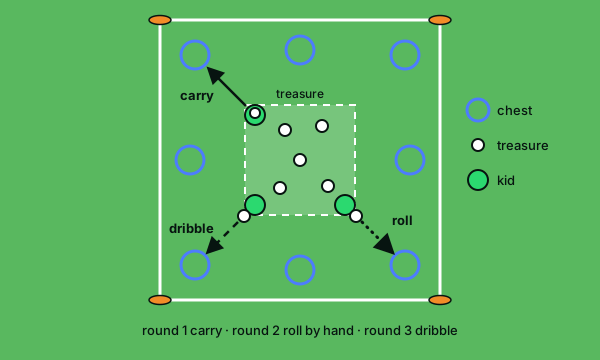 Treasure Hunt: carry it, roll it, then dribble it back to your chest.
Zoo Day
Goal: the guide’s movement skills (jumping and landing, short steps, running) with a ball. Setup: a 15×15-yard square of flat cones, one ball per kid. Duration: 4-5 minutes, 20-30 seconds per animal. How to play: call out an animal, and everyone copies it:
- “Bunny!”: small two-footed hops on the spot, hugging the ball.
- “Frog!”: one jump forward, ball in both hands, landing softly on both feet.
- “Penguin!”: tiny steps, nudging the ball between the feet.
- “Elephant!”: a slow walk, pushing the ball with your “trunk” (one foot).
- “Cheetah!”: a fast dribble to a flat cone, then stop the ball.
Easier: penguin and elephant only. Harder: a kid invents the next animal. The guide asks coaches to “Provide opportunity for players to choose their own activity/ challenge.” Safety: play on grass; land softly on both feet; never step or jump on the ball; no running with the ball in your hands; if kids bump, make the square bigger.
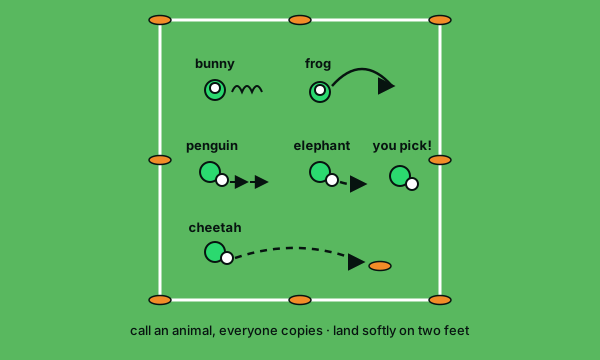 Zoo Day: call an animal and everyone copies it, ball and all.
Egg Catch
Goal: throwing, catching and stopping the ball with the sole (“receiving” is on the guide’s list of soccer skills). Setup: pairs of one kid and one grown-up 2-3 yards apart, one ball per pair, 4-5 yards between pairs. Short on grown-ups? One can roll to two or three kids standing in a small arc, in turn. Duration: 4 minutes, with a new challenge every minute. How to play: the grown-up rolls the “egg” for the kid to catch; next, the kid stops it with the sole “without breaking it”; then the grown-up tosses it underhand, soft, at tummy height. The kid rolls or passes it back each time. Easier: rolling and catching only, closer together. Harder: stop it with the sole and pass it back from 3-4 yards. Safety: tosses are always underhand, soft and to the tummy, never at the face; start with rolling; nothing with the head.
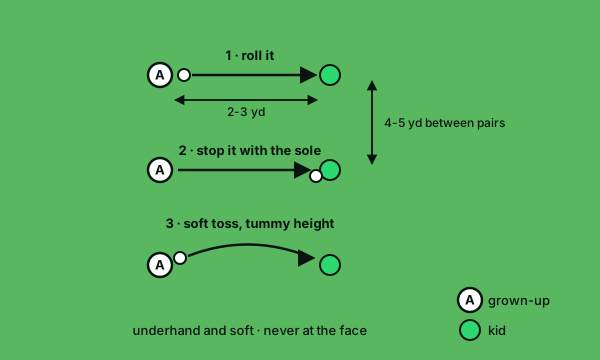 Egg Catch: roll it, stop it with the sole, then a soft toss to the tummy.
Ball games: dribbling and stopping
The U5 guide’s soccer skills are “dribbling, running with the ball, receiving, shooting,” with a ball in every activity. My take: one ball per kid most of the time, so nobody waits for a turn.
Space Bubbles
Goal: dribbling among other kids without bumping, head up. Setup: a 20×20-yard area for 8-10 kids (smaller with fewer), one ball per kid. Duration: 4 minutes, in 45-second rounds with a pause. How to play: each kid dribbles inside an invisible “bubble.” If two bubbles touch, it’s “Pop!”: both kids stop, walk once around their own ball and carry on. Easier: walk with the ball in a bigger area. Harder: a smaller area, or call “Big bubble!” (get away from everyone) and “Tiny bubble!” (tiny touches). Safety: lots of pops means the area is too small; nobody dribbles backward.
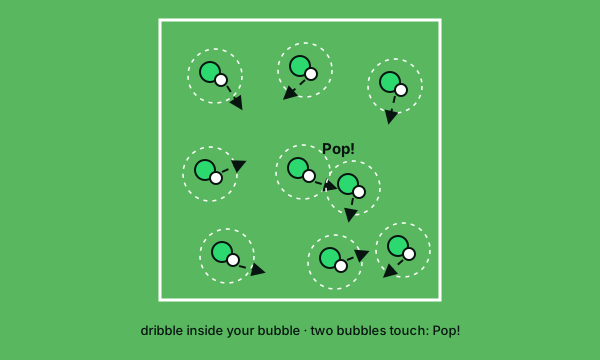 Space Bubbles: keep your bubble clear. If two bubbles touch, it’s “Pop!”
Park the Car
Goal: dribbling to a spot and stopping the ball with the sole, choosing where to go (“Encourage player choice,” in the guide’s words). Setup: a 20×20-yard area with more “garages” than kids (hoops or small squares of flat cones), and one ball (“car”) per kid. Duration: 5 minutes, in rounds of 45-60 seconds. How to play: kids drive anywhere. On “Park!”, each one drives into an empty garage and stops the car with the sole; on “Beep beep!”, back on the road. Take a garage away now and then, always keeping more garages than kids. Easier: big garages; a hand stop is fine at first. Harder: park with the foot you call, or pull the car in with the sole. Safety: one car per garage; if it’s taken, find another; no racing for the last one.
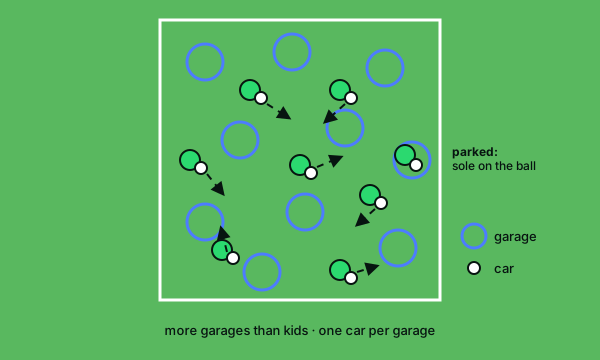 Park the Car: drive anywhere, then park in an empty garage on “Park!”
Kicking games
“Shooting” closes the guide’s list of soccer skills. In both games, every kick goes the same way and stays low, and nobody kicks toward another kid.
Knock Down the Castle
Goal: kicking at a close target with the inside of the foot or the laces. Setup: a “castle wall” of 6-8 tall cones in a line. Kids stand on a start line 3-4 yards away, 2 yards apart and all on the same side, each with a ball; spare balls go in a bag behind them. Duration: 4-5 minutes. How to play: kick to knock down a cone, then take a spare from the bag. On “Collect!”, everyone walks around the ends of the wall and brings a ball back. A grown-up rebuilds the wall, everyone lines up, and you go again. Easier: 2 yards away and bigger cones. Harder: 5 yards away, or dribble 2-3 yards and kick before a line. Safety: everyone kicks the same way; nobody stands behind or beside the wall; nobody goes for a ball until “Collect!”; kicks stay low.
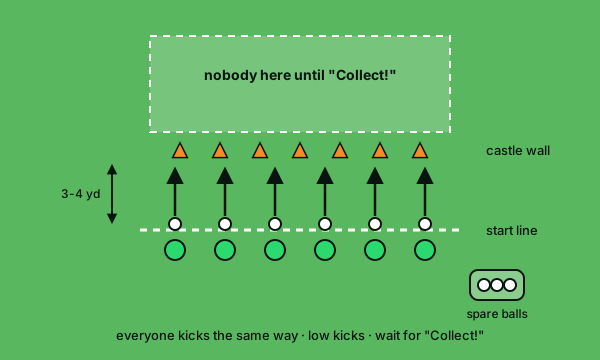 Knock Down the Castle: everyone kicks the same way, and nobody crosses until “Collect!”
Through the Tunnels
Goal: first passes to a target, with grown-ups as the tunnels. Setup: a 15×15-yard area with 3-4 grown-ups standing still with their feet wide apart (“tunnels”), about 5 yards apart, or 1-yard cone gates instead. One ball per kid. Duration: 4-5 minutes, in 60-second rounds. How to play: dribble to a tunnel, pass the ball under it from 1-2 yards, run around the grown-up, collect the ball and find another tunnel. Count the tunnels in 60 seconds. Easier: wide cone gates, passing from very close. Harder: pass from 3 yards, use the other foot, or go only when the grown-up says “Open!” Safety: the ball goes through and the kid goes around, never crawling between the legs. Grown-ups stand still and face the kid; one kid per tunnel; soft passes along the ground.
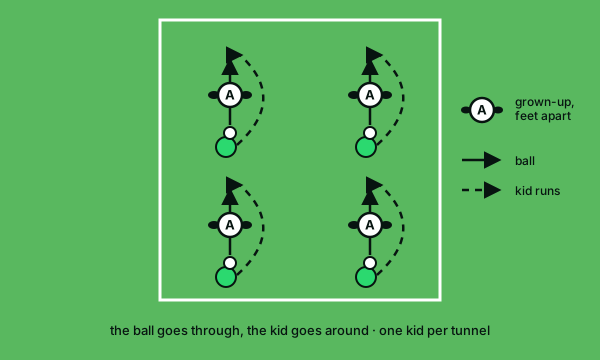 Through the Tunnels: the ball goes through, the kid goes around.
Small games: 1v1, 2v1 and 2v2
U.S. Soccer’s U5 guide lists “Small-sided games 1v1; 2v1; 2v2,” and its format chart adds that “Training games at all age groups should include unbalanced teams (2v1, 3v2 etc).”
Mini Match
Goal: a tiny game with lots of goals and “No set playing positions.” Setup: mini-fields of 12×8 yards (10×6 for 1v1) with a 3-yard cone goal at each end, 5 yards between fields, and a grown-up at each field with 2-3 spare balls. Duration: 2-minute games with water after each one; 3-4 games, switching opponents. How to play: 1v1, 2v1 or 2v2, with no goalkeepers. After a goal or when the ball goes out, the grown-up rolls a new ball to the team that didn’t have it. Easier: 2v1, or a grown-up on the smaller team who only walks and passes; 4-yard goals. Harder: 2-yard goals, or 2v2. Safety: feet to the ball; no pushing, holding or going to the ground. If anyone falls or kids pile up, stop play and roll in a new ball. Grown-ups who join in only walk.
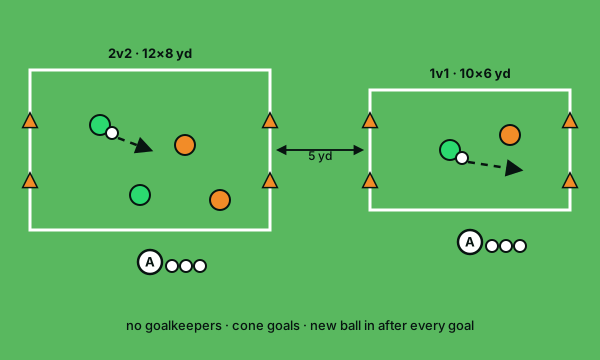 Mini Match: no goalkeepers, and a new ball goes in after every goal.
How do you put these games into a practice?
Three or four games make a session, with water in between: a Body game while kids arrive, one or two Ball or Kicking games, and Mini Match to finish. To sketch your own session on paper, print a blank practice plan template.
No rule sets practice length for 4-year-olds. AYSO’s Kickstart program for 5- and 6-year-olds caps a session at “1 hour maximum, includes organizing time and breaks,” and says to “Adjust play time and breaks as needed to suit your players.” U.S. Soccer’s U5 guide only says “Use lots of short breaks.” Some coaching sites suggest 30 to 45 minutes; we couldn’t find an official number for this age. My take: shorter beats longer.
Keep the groups small, too: the Kickstart manual’s “Group Size Guidelines” give 4-6 players for ages 3-4. It also explains why every game here has a story: “This age group needs to be entertained, so create colorful images, vivid landscapes to stimulate imaginations…and get into character for the activity!”
FAQ
How long should soccer practice be for 4-year-olds?
We couldn’t find an official number. AYSO’s Kickstart, for 5- and 6-year-olds, caps sessions at one hour, organizing time and breaks included. For 4-year-olds, my take is shorter, with lots of short breaks.
Do these work as U5 soccer drills?
Yes. They’re built on U.S. Soccer’s guide to coaching U5s: small games up to 2v2, a ball in every activity, and hands as well as feet.
What about a mixed group of 4- and 5-year-olds?
Use each game’s easier and harder versions, group by size for anything with chasing, and move the older kids on to the drills for 5-year-olds when they’re ready.
What size ball does a 4-year-old use?
Size 3 in the rulebooks we checked for the youngest groups: US Youth Soccer’s 6U (“#3”), Cal South’s 5U and AYSO’s Kickstart (“a size 3 soccer ball”). You may see “size 3 or 4” online, but none of these puts a 4-year-old on a size 4. Check your league. More in soccer ball size by age.
Should 4-year-olds play goalkeeper?
None of these games uses one. U.S. Soccer’s U5 guide says “No set playing positions” and that all players should get a chance in goal “(if a GK is used).” If kids want to try, roll the ball and skip the diving.
What if my 4-year-old won’t join in?
Let them watch for a while next to their grown-up, with no pressure, and invite them into the next game. The AAP’s advice for kids this age is play “without pressure to perform.” If soccer has stopped being fun, see my child wants to quit soccer.
Sources
- U.S. Soccer, Guide to coaching U5s (The U.S. Way, 2026): documents.ussoccer.com
- U.S. Soccer, Age-appropriate soccer formats for training and games (The U.S. Way, 2026): documents.ussoccer.com
- American Academy of Pediatrics, HealthyChildren.org, Burnout in Young Athletes: How to Keep the Fun in Sports (updated 2024): healthychildren.org
- US Youth Soccer, AYSO and US Club Soccer, “Updated Decision on Age Group Formation” (June 10, 2025): usyouthsoccer.org
- AYSO, Age Group Chart, Starting Fall 2026 Season: ayso.org
- US Youth Soccer, Policy on Players and Playing Rules (as of June 23, 2026): usyouthsoccer.org
- Cal South, 2026-27 PDI Matrix: calsouth.com
- North Texas Soccer, Bylaws and Rules 2026/27: ntxsoccer.org
- Florida Youth Soccer (FYSA), Rules (last modified August 2026): fysa.com
- AYSO, 6U Kickstart Program Manual: wiki.ayso.org
- AYSO, Referee Guideline 2026-2027: wiki.ayso.org
- AYSO, Safe Haven Policies (AYSO wiki, accessed October 2026): wiki.ayso.org
- U.S. Soccer, Heat Guidelines (Recognize to Recover): folsomlakesurf.org
- U.S. Consumer Product Safety Commission, Guidelines for Movable Soccer Goals: cpsc.gov

Peter D. — Peter D. is KickZone’s editor. Based in Spain and closely involved in grassroots youth soccer there, Peter turns the way Spanish kids learn the game into practical help for US parents and volunteer coaches. Rules always come straight from the official rulebooks, cited.