
What to Bring to Soccer Practice: A Checklist for Kids 4-8
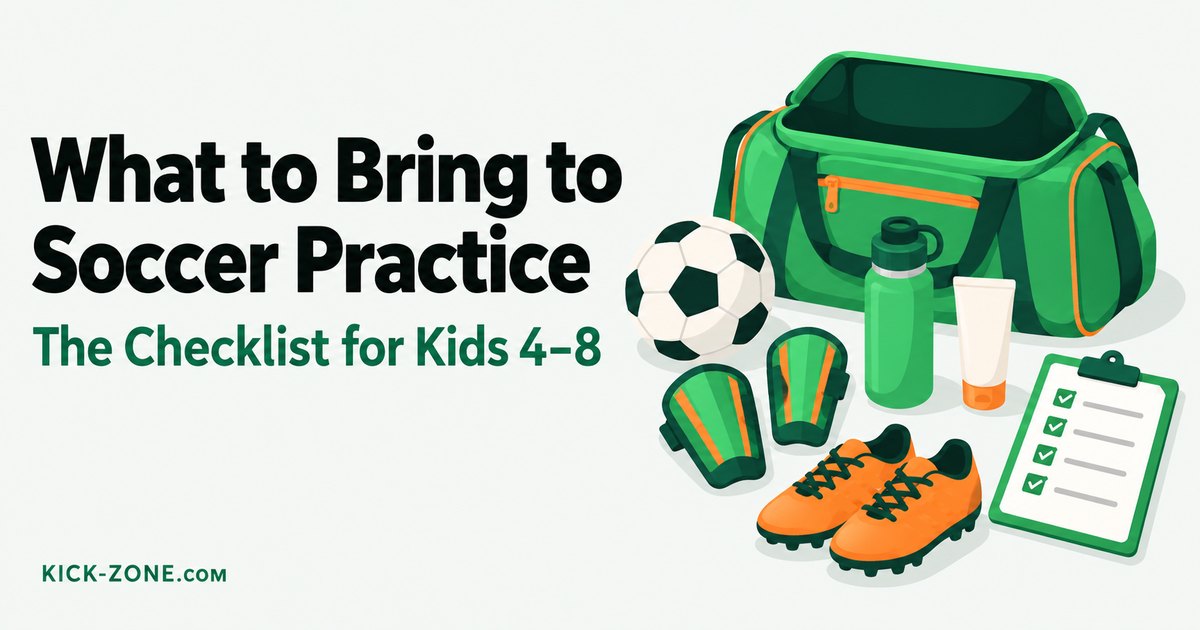
For a 4- to 8-year-old, the practice bag is short: shin guards that fit completely under long socks, shoes that suit your league, the playing surface and its safety rules, and a labeled water bottle. Put sunscreen on before you leave, and pack any medicine your child’s doctor has prescribed, with the doctor’s plan. A medical alert bracelet stays on, secured; other jewelry stays home, because AYSO doesn’t allow it, even taped over.
What should my child bring to soccer practice?
Here’s the whole list, split into what the rules require, what depends on your program, and what keeps your child safe and comfortable. Your league’s handbook has the final word.
| What to bring | Why | Where it comes from |
|---|---|---|
| Required for play | ||
| Shin guards | Required to play. AYSO requires them “in all practices and games” | AYSO; North Texas Soccer |
| Long soccer socks | They have to cover the shin guards completely | AYSO |
| Shoes that suit your league and field | Soccer cleats or athletic shoes; the referee judges what’s safe | AYSO; AYSO Kickstart |
| Check with your coach | ||
| A size 3 ball with your child’s name on it | AYSO’s Kickstart program asks each child to bring one; other programs may supply balls | AYSO Kickstart |
| Safety & comfort | ||
| A full, labeled water bottle | “Unlimited access to water during practice and competition” | U.S. Soccer; AYSO Kickstart |
| Sunscreen, put on before you leave | Broad-spectrum, SPF 15 or higher | American Academy of Pediatrics |
| Any medicine the doctor prescribed, plus the doctor’s plan | Quick to reach, and the coach knows where it is | Your child’s doctor; your league |
| A rain jacket or long sleeves | Weather changes fast on an open field | — |
| A soft hair tie or small flat clips | Only if they’re safe and your referee accepts them | AYSO |
Download the free printable practice checklist (PDF): one page to stick by the door and tick before you leave.
If getting out the door has turned into a fight before every practice, the bag isn’t the problem: see what to do when your child wants to quit soccer.
Do kids need cleats for soccer practice?
Not always. AYSO’s Kickstart program for 5- and 6-year-olds lists “soccer shoes or appropriate athletic footwear,” and AYSO’s referee guideline says other shoes are acceptable “if, in the opinion of the Referee, they are not dangerous to the player wearing them or to another player.” Whether sneakers will do depends on your league, the playing surface and its safety rules, so ask your coach before you buy anything.
If your child does wear cleats, the referee checks them for sharp edges. AYSO calls the blanket claim that toe cleats are illegal “too narrow,” but that isn’t a green light for baseball cleats: the referee looks at the actual pair and decides.
My take: for a first season, there’s no rush to buy expensive cleats. Get shoes that fit, grip the surface your child plays on and pass your league’s rules, and upgrade later if soccer sticks.
One health note: if your child keeps complaining of heel pain, mention it to your pediatrician instead of switching shoes on a guess. The American Academy of Pediatrics also asks parents to talk with kids about “the mistaken idea that ‘playing through the pain’ is safe.”
Do shin guards go over or under the socks?
Under, completely. AYSO requires shin guards to be “completely covered by their socks,” and its referee guideline adds that players can’t wear them over the socks and then roll the socks down on top. Makeshift guards don’t count either: AYSO’s guide specifically rules out cardboard and rolled-up newspaper. None of the rulebooks we checked sets shin guard sizes, so go by the size chart on the package and make sure the sock covers the whole guard.
What should kids leave at home?
Start with what stays on. A medical alert bracelet is an exception to the jewelry rule: AYSO allows it, as long as it’s secured with tape or a cloth wristband and the information stays visible. AYSO’s own guide explains why it matters: if the bracelet is removed and lost, “the child might be put in danger.”
Everything else that counts as jewelry comes off before practice or a game in AYSO: necklaces, rings, bracelets (friendship bracelets included), watches, earrings and hair charms. Taping over jewelry isn’t allowed, and neither is covering it with padding or a bandage. A few items are fine with conditions:
- Prescription glasses: allowed with a retaining strap. Prescription goggles need the referee’s OK, and hard plastic spectacle guards aren’t permitted.
- Medical devices such as hearing aids or insulin pumps: allowed if they’re padded.
- Cultural, religious and medical items: permitted if they’re “safely and securely covered.”
Two firm no’s in AYSO. Casts and splints aren’t allowed at practice or games, and taking one off at the field to play disqualifies the player from that session; when your child can play again is up to their doctor and your league. Hard-brimmed baseball caps aren’t allowed during play either, even worn backward.
This isn’t just an AYSO quirk: Florida Youth Soccer, for one, applies the Laws of the Game to equipment and jewelry. The details above are AYSO’s, so check your own league’s handbook.
What should you pack for heat, sun and storms?
Water. Send a full, labeled water bottle every time. U.S. Soccer’s heat guidance calls for “unlimited access to water during practice and competition,” and on hot days, more and longer water breaks, a shorter practice or moving it to a cooler time. You’ll still find old-school jokes online that water breaks are for the weak. That’s a joke, and the official guidance says the opposite. There’s no official amount by age, so let kids drink whenever they want.
U.S. Soccer lists early signs of heat illness such as weakness or fatigue, headache, nausea and dizziness, along with confusion, slurred speech and loss of balance. If a child shows signs like these, stop and get them out of the heat and into the shade. Exertional heat stroke is a medical emergency: call 911. Our first-time coach guide covers heat planning from the coach’s side.
Sun. Put sunscreen on before you leave home. The American Academy of Pediatrics recommends a broad-spectrum sunscreen with SPF 15 or higher (up to 50), applied 15 to 30 minutes before going outside and reapplied every 2 hours or after sweating, and reminds parents that kids can burn on cloudy days too. A brimmed hat is great on the sideline and during breaks, but in AYSO, hard-brimmed caps aren’t allowed during play. A referee may allow a soft-brimmed hat for a player who is unusually susceptible to skin cancer or who wears one for religious reasons. If a sunburn blisters or comes with pain or fever, the AAP says to call your child’s doctor.
Storms. If you hear thunder, stop and get everyone to shelter right away, before anyone packs up the gear. AYSO’s referee guideline is blunt: “When thunder is heard, it is within striking distance. Seek shelter immediately.” Don’t wait for the rain, and don’t head back out just because it stopped. Play resumes after 30 minutes with no thunder, or when the community’s official all-clear siren sounds, and the facility’s own rules come first. The only thing to “pack” for a storm is knowing where you’d go before practice starts.
What does the coach need to know about your child’s medicine?
If your child’s doctor has prescribed medicine, such as an inhaler or an epinephrine auto-injector, it comes to every practice with the doctor’s plan, and it has to be quick to reach, not buried at the bottom of a bag. Tell the coach where it is, and ask your league who is responsible for it during practice. Don’t assume a volunteer coach is trained or authorized to give medicine. Follow the plan from your child’s doctor.
The CDC’s food allergy guidelines were written for schools and early childhood programs, not youth soccer, but the principles carry over. Many families provide an Emergency Care Plan from the child’s allergist or doctor, and the guidelines call “quick access to and immediate availability of epinephrine” essential. They also put providing the prescribed auto-injectors on the parents.
Fill in the medical section of your league’s registration carefully, too. In AYSO, it’s the coach’s job to have the player registration forms at all practices and games, and the Kickstart manual notes that each child’s form includes an Emergency Treatment Authorization. Keep health details to the people who need them, like the coach and team manager, not the group chat. Our team parent guide covers how teams handle allergy information.
What should parents bring to the sideline?
Keep it simple: water and sunscreen for yourself, a warm layer, and a charged phone with your emergency contacts. If you bring a chair or a pop-up canopy, set it back from the edge of the field and anchor the canopy the way the manufacturer says. Florida Youth Soccer, for example, asks for tents and chairs to sit “a safe distance from sidelines… usually 3-5 feet minimum” on game days. Follow your field’s sideline and canopy rules.
If you drop off instead of staying, check in with the coach first and be back on time. AYSO’s child-protection rules say “parents/guardians must establish contact with the coach before leaving their child,” and that no child is left unsupervised after a practice or game.
What changes on game day?
Game day adds the uniform, if your league provides one, and snack duty if it’s your turn (ask about allergies first, as our team parent guide explains; for what to bring, see soccer snack ideas). Leave a few spare minutes, too: at AYSO games, the referee checks every player’s shin guards, jewelry and shoes at check-in.
What do kids bring to practice in Spain?
What I see in grassroots soccer in Spain is a little different. The uniform is mandatory: the club supplies it and each family pays for it. From 5 to 8, most kids wear futsal shoes, the flat indoor soccer shoe, and sometimes turf shoes with lots of small studs for artificial grass. Whether parents can watch practice depends on the club. Some allow it, some only for the last five minutes, and some only let parents pick up at the exit gate, and it’s allowed less and less.
FAQ
Does my child need their own ball?
In AYSO’s Kickstart program, yes: each child brings a size 3 ball labeled with their initials or last name. Other programs may supply balls, so ask your coach. If you do buy one, size 3 is the size the rulebooks we checked use at this age; see our soccer ball size by age chart and our U6 and U8 rules guides. A ball at home is also an easy way to try a few of our soccer drills for 6-year-olds.
Can my child wear earrings to soccer practice if they’re taped?
Not in AYSO. Jewelry has to be removed, and tape, padding or a bandage over it isn’t enough. For a new piercing, AYSO allows soft, flexible material to keep it open, with the referee’s approval.
Should my child wear a mouthguard?
AYSO doesn’t prohibit mouthguards and encourages parents to ask their child’s dentist or orthodontist whether one is right for their child. Not prohibited doesn’t mean required.
Do kids need goalie gloves?
Usually not at the start. Most introductory U5-U8 4v4 programs don’t use a goalkeeper: AYSO plays 4-a-side with no goalkeepers through U8, and Cal South’s matrix says no goalkeeper from 5U to 8U. Check your league, though, because some U8 formats do use one. Florida’s 8U recreational travel and competitive teams, for example, play 7v7 with a goalkeeper.
What if my child has a cast?
In AYSO, players can’t practice or play with a cast or splint, and taking one off at the field to play disqualifies them for that session. When your child can play again is up to their doctor and your league’s rules.
Sources
- AYSO, Referee Guideline 2026-2027 — wiki.ayso.org
- AYSO, 6U Kickstart Program Manual — wiki.ayso.org
- AYSO, Safe Haven Policies — wiki.ayso.org
- North Texas Soccer, 2026/2027 Bylaws and Rules — ntxsoccer.org
- Florida Youth Soccer Association, FYSA Rules (August 2026) — fysa.com
- Cal South, 2026-27 PDI Matrix — calsouth.com
- U.S. Soccer, Heat Guidelines (Recognize to Recover) — mirror copy
- American Academy of Pediatrics, HealthyChildren.org, Sun Safety: Information for Parents About Sunburn & Sunscreen (updated 2024) — healthychildren.org
- American Academy of Pediatrics, HealthyChildren.org, Preventing Overuse Injuries in Young Athletes: AAP Policy Explained (updated January 2024) — healthychildren.org
- CDC, Voluntary Guidelines for Managing Food Allergies in Schools and Early Care and Education Programs (2013) — mirror copy

Peter D. — Peter D. is KickZone’s editor. Based in Spain and closely involved in grassroots youth soccer there, Peter turns the way Spanish kids learn the game into practical help for US parents and volunteer coaches. Rules always come straight from the official rulebooks, cited.