
Soccer Field Size by Age: Field & Goal Dimensions (U6-U19)
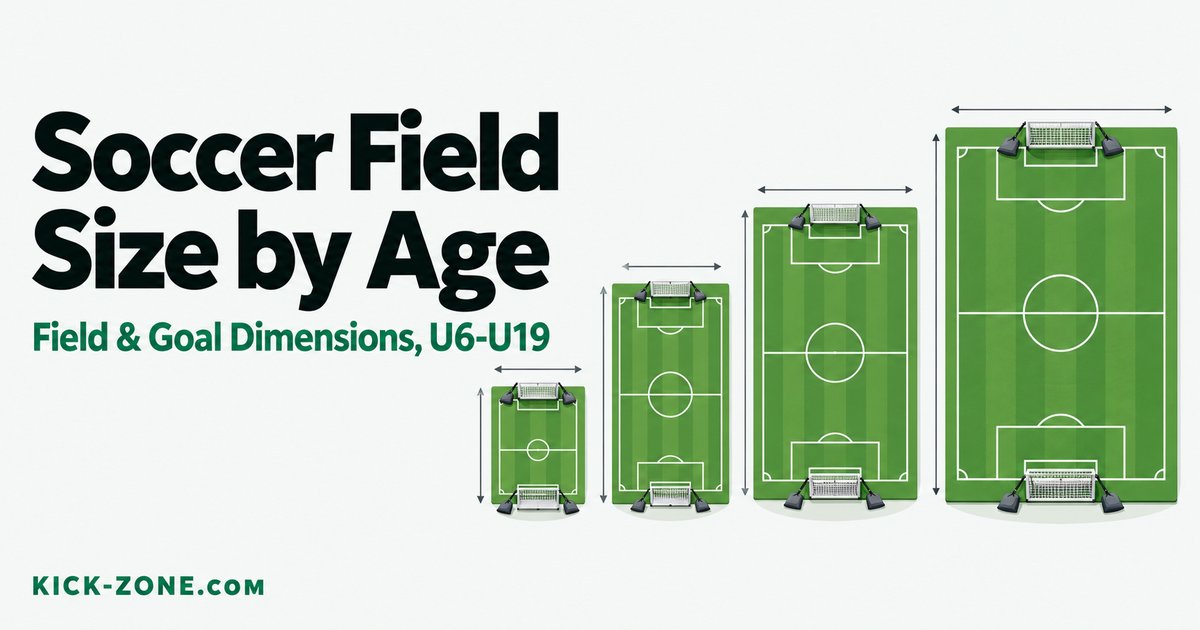
Youth soccer fields grow with the age group. In the rulebooks I checked, U8 and younger play small-sided games, usually 4v4 or smaller, on a field about 25-35 yards long by 15-25 wide, with goals no bigger than 4 feet high by 6 feet wide. U9-U10 usually moves to 7v7 on 55-65 by 35-45 yards, U11-U12 to 9v9 on 70-80 by 45-55, and U13 and up to 11v11 on a full-size field. Check your league’s handbook.
Before you buy or set up any goal: it has to be anchored or weighted down, and nobody climbs or hangs on it. The full checklist is right after the chart.
Soccer field and goal size by age (chart)
| Age group | Players per side | Field: length × width | Largest goal: height × width |
|---|---|---|---|
| U5-U6 | Small games, usually 3v3 or 4v4 with no goalkeeper (U.S. Soccer’s 2026 guidance: no structured games, just 1v1 to 2v2) | 25-35 × 15-25 yd (75-105 × 45-75 ft) | 4 × 6 ft |
| U7-U8 | Usually 4v4 with no goalkeeper (Florida’s 8U travel and competitive teams: 7v7 with a goalkeeper) | 25-35 × 15-25 yd (75-105 × 45-75 ft) | 4 × 6 ft |
| U9-U10 | Usually 7v7, with a goalkeeper | 55-65 × 35-45 yd | 6.5 × 18.5 ft (AYSO and North Texas recommend 6.5 × 12) |
| U11-U12 | Usually 9v9, with a goalkeeper | 70-80 × 45-55 yd | 7 × 21 ft (AYSO and North Texas recommend 6.5 × 18.5) |
| U13 and up | 11v11 | Full size: 100-130 × 50-100 yd | 8 × 24 ft |
Field and goal sizes are AYSO’s for 2026-27. Cal South’s matrix lists the same numbers through 12U, and North Texas recommends the same ranges from 8U to 12U, except 44-55 yards wide at 12U. The feet are my arithmetic (1 yard = 3 feet).
- Goals are height × width: a 4 × 6 goal is 4 feet tall and 6 feet wide.
- Maximum or recommended? From U9, AYSO and North Texas list a maximum and a smaller recommended goal. The chart shows the maximum; Cal South gives a range between the two.
- Which row is your child’s? It depends on the age group, not the birthday: this season an 8-year-old can be U8 or U9, and some leagues group two ages together. Check our age group calculator.
Ball sizes by age are in soccer ball size by age.
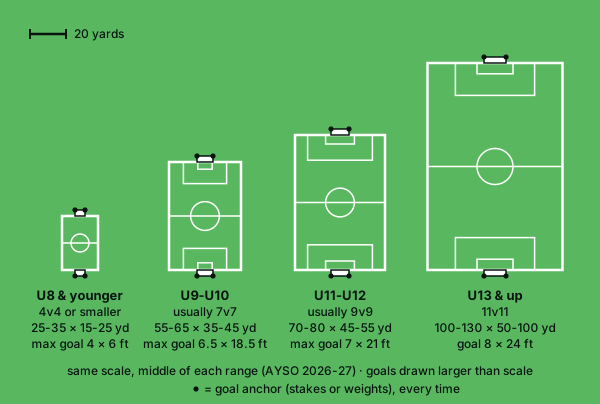 Drawn to the same scale at the middle of each range. Goals are drawn bigger than scale so you can see them, and every one is anchored.
Before you buy or set up a goal: anchor it, check it, and nobody climbs on it
The Laws of the Game are short on this: “Goals (including portable goals) must be firmly secured to the ground.” The how comes from the U.S. Consumer Product Safety Commission (CPSC), whose guidelines are written for “full-size or nearly full-size” movable goals. The same habits apply to any goal, small pop-ups included:
- Anchor or weigh it down, every time: “Securely anchor or counterweight movable soccer goals at ALL times.” On hard surfaces such as artificial turf, where an anchor can’t go into the ground, sandbags or other counterweights “could be an effective alternative.” Net pegs hold the net only: “Net pegs should NOT be used to anchor the movable soccer goal.”
- Check the frame and hardware before every use, and replace damaged or missing parts right away.
- Nobody climbs or hangs on it: “NEVER allow anyone to climb on the net or goal framework.” The CPSC’s tip-over warning is about children who “climb on goals (or nets) or hang from the crossbar.” Strong wind can tip a goal over, too.
- Level ground only: “Movable soccer goals should only be used on LEVEL (flat) fields.”
- Never leave one standing unattended: “Most of the incidents occurred when the goals were unattended.” Pop-ups come down after use; big goals get chained, locked or stored by whoever runs the field.
- Moving big goals isn’t a parent’s job: they “should only be moved by authorized and trained personnel.”
Pop-ups get installed and secured the way the manufacturer says and your facility allows (on artificial turf, stakes may not be an option). AYSO also tells referees to “Make sure that the goals and nets are properly secured” before a game.
Before you buy any goal, new or used, search cpsc.gov for recalls and warnings. For example, on December 19, 2024, the CPSC warned consumers to immediately stop using Sport Nets 4x8 portable soccer goals: the exposed metal tip at the top of the vertical poles is an impalement hazard, and in April 2023 a high school student in Washington State died after falling onto it while playing around the goal. The manufacturer refused to recall them, so the CPSC asks owners to stop using them and dispose of them, and asks everyone not to buy, sell or give them away. They’re portable 4x8 goals with four vertical posts, a mesh net and the “Sport Nets” logo on a red cloth cover on the front posts. The warning covers that product, not every 4x8 goal.
How big is a U6 or U8 soccer field?
About 25-35 yards long by 15-25 wide, or roughly 75-105 by 45-75 feet if you’re marking one out with cones (my arithmetic). That’s AYSO’s size for “U8 and younger,” the numbers Cal South’s matrix lists for 5U through 8U and North Texas’s recommendation for “8U and younger,” so in all three a U6 field and a U8 field are the same size. U.S. Soccer’s 2026 formats chart and US Youth Soccer’s national policy don’t list field sizes, and Florida says to “Follow US Youth Soccer requirements for field size, ball size, etc.”
AYSO’s Kickstart program for 5- and 6-year-olds suggests its own areas: approximately 30 × 18 yards for 3v3 and 35 × 23 yards for 4v4 (about 90 × 54 and 105 × 69 feet), with four goals, “one on each corner approximately 12 yards apart.” They’re session guidelines for Kickstart, not a rule for every U6 league.
The rest of the rules at these ages are in our U6 soccer rules and U8 soccer rules guides.
What size is a U8 soccer goal?
4 feet high by 6 feet wide, at most. AYSO lists 4 × 6 feet as both the maximum and the recommended goal for U8 and younger; Cal South gives “Height 4 / Width 6” for 5U to 8U, and North Texas “4 ft. x 6 ft.” AYSO’s Kickstart also allows pop-ups or cones: “Four 4 x 6 goals (preferred) or four larger pop-up goals (tall cones can also be used).”
Buying one for practice or the backyard? For U8 and younger, stay within the rulebooks’ 4 × 6-foot maximum, pick a goal you can anchor or weigh down on your surface, and go through the checklist above first, cpsc.gov included.
How many players are on the field at each age?
Here’s what each rulebook says, from U.S. Soccer’s 2026 formats chart to the state associations:
| Organization | U5-U6 | U7-U8 | U9-U10 | U11-U12 | U13 and up |
|---|---|---|---|---|---|
| U.S. Soccer (2026) | “No Structure”: 1v1, 2v1, 2v2 | Up to 4v4 | Up to 7v7 | Up to 9v9 | Up to 11v11 |
| US Youth Soccer | 6U: “No more than 4, 3 strongly recommended” | 8U: “No more than 5, 4 strongly recommended” | 10U: “No more than 7, 6 strongly recommended” | 11U and 12U: “No more than 11, 8 strongly recommended” | Not listed |
| AYSO | 4-a-side, no goalkeepers | 4-a-side, no goalkeepers | 7-a-side | 9-a-side | 11-a-side |
| Cal South | 4v4, no goalkeeper | 4v4, no goalkeeper | 7v7 with a goalkeeper | 9v9 with a goalkeeper | 11v11 |
| North Texas (recommended play) | 4v4 or 3v3 | 4v4, no goalkeeper | 7v7 (10U) | 9v9 (12U) | 11v11 (13U and older) |
| Florida | Up to 4v4, no goalkeeper | Up to 4v4, no goalkeeper (8U travel and competitive: 7v7 with a goalkeeper) | 7v7 with a goalkeeper | 9v9 with a goalkeeper | 11v11 with a goalkeeper |
Two US Youth Soccer numbers are easy to mix up: the ones in the table come from its Rule 303, while its Rule 301 says state associations may not approve games for teams 10 and under “unless those games are conducted with not more than 8 players on each side.”
Florida’s 8U recreational travel and competitive teams are the documented 8U exception. Florida points to US Youth Soccer for field sizes, and US Youth Soccer’s national policy doesn’t list them, so I couldn’t confirm the field those teams use. For roster size (kids on the team, not on the field), see the FAQ in our U8 soccer rules guide.
U9 to U12: how big are 7v7 and 9v9 fields?
- U9-U10 (7v7): 55-65 yards long by 35-45 wide. AYSO and North Texas cap the goal at 6.5 × 18.5 feet and recommend 6.5 × 12; Cal South’s matrix gives a range, “6.5x12 to 6.5x18.5.”
- U11-U12 (9v9): 70-80 yards long by 45-55 wide (North Texas: 44-55 at 12U). AYSO and North Texas cap the goal at 7 × 21 feet and recommend 6.5 × 18.5; Cal South gives “6.5x18.5 to 7x21.”
From U9, the rulebooks that address it add a goalkeeper, and AYSO, Cal South and North Texas add a build-out line at U9-U10. If your 8-year-old has moved up to U9, the middle of the length range doubles, from about 30 yards to about 60 (my arithmetic).
How big is a full-size soccer field?
Under the Laws of the Game, 100-130 yards long (90-120 m) by 50-100 wide (45-90 m), with the touchline longer than the goal line; international matches use 110-120 by 70-80 yards. The goal is 8 yards (7.32 m) between the inside of the posts and 8 feet (2.44 m) from the ground to the lower edge of the crossbar: the 8 × 24-foot goal in youth charts.
AYSO uses the same 100-130 by 50-100 yards for U13 and older, and says field dimensions and goals should, whenever possible, “conform to the IFAB Laws of the Game for U13 and older.” Cal South’s matrix says “FIFA Standard” from 13U to 19U, with “8 x 24” goals. North Texas gives only maximums: 75 yards wide by 112 long at 14U and 16U, 80 by 112 at 19U and 80 by 120 for adults, with 8 × 24-foot goals.
Why is my child’s field a different size?
Because the rulebooks allow for it. AYSO leaves field dimensions, markings and goals “at the discretion of the Region,” and North Texas presents its sizes as recommendations, “Realizing that we must generally accept and play upon fields furnished by the various municipal parks departments.”
Above them, the Laws of the Game let national associations modify, for youth and grassroots football, the “size of the field of play,” the “size, weight and material of the ball” and the “width between the goalposts and height of the crossbar from the ground.” The Laws don’t set youth sizes; in the US, the numbers in this article come from AYSO and the state associations. Your league’s handbook has the final word.
FAQ
What size goal for U10?
AYSO and North Texas allow up to 6.5 × 18.5 feet (height × width) and recommend 6.5 × 12. Cal South gives a range between the two.
Is a U6 field the same size as a U8 field?
Yes, where it’s specified. AYSO (25-35 by 15-25 yards), Cal South and North Texas use the same size for every group from U8 down. AYSO’s Kickstart program uses its own areas, described above.
Where should parents stand during a game?
AYSO’s referee guideline calls for a spectator control line, where possible, at least 3 yards from the touchline, asks coaches and officials to help keep spectators behind it, and says “Spectators shall not be allowed behind the goal lines” (authorized photographers aside). Florida asks for tents and chairs to sit “a safe distance from sidelines… usually 3-5 feet minimum.” Follow your field’s rules.
How many players are on a U8 soccer team?
On the field, usually 4. The roster limit varies by organization: see the FAQ in our U8 soccer rules guide.
What about futsal?
Futsal has its own court, goals and ball. See futsal vs. soccer for how it compares.
Sources
- AYSO, Referee Guideline 2026-27 (Law 1 and Law 3 appendix tables) — wiki.ayso.org
- AYSO, 6U Kickstart Program Manual — wiki.ayso.org
- Cal South, 2026-27 PDI Matrix — calsouth.com
- North Texas Soccer (NTSSA), Bylaws and Rules 2026/2027 — ntxsoccer.org
- US Youth Soccer (USYS), Policy on Players and Playing Rules (as of June 23, 2026) — usyouthsoccer.org
- Florida Youth Soccer (FYSA), Rules (last modified August 2026) — fysa.com
- U.S. Soccer, Age-Appropriate Formats (“The U.S. Way,” 2026) — ussoccer.com
- The IFAB, Laws of the Game 2026/27, Law 1: The Field of Play — theifab.com
- The IFAB, Laws of the Game 2026/27, General Modifications — theifab.com
- U.S. Consumer Product Safety Commission, Guidelines for Movable Soccer Goals — cpsc.gov
- U.S. Consumer Product Safety Commission, CPSC Warns Consumers to Immediately Stop Using Sport Nets 4x8 Portable Soccer Goals Due to Impalement Hazard; One Death Reported (Warning 25-075, December 19, 2024) — cpsc.gov

Peter D. — Peter D. is KickZone’s editor. Based in Spain and closely involved in grassroots youth soccer there, Peter turns the way Spanish kids learn the game into practical help for US parents and volunteer coaches. Rules always come straight from the official rulebooks, cited.